By Jerry Maleek Gearin, Journalism Guild Chair
One obstacle after another, Althea Neale Gibson broke various ethnic, athletic, and social barriers in her quest to make history in American sports.
Gibson was born on August 25, 1927 in Silver, South Carolina to Daniel and Annie Bell Gibson. Her parents worked as sharecroppers on a cotton farm.
Gibson was banned from playing in the United States National Championships at Forest Hills (the US Open), a place where black people had never played, according to Wikipedia the Free Encyclopedia.
“No Negro player, man or woman, has ever set foot on one of these courts”, wrote Journalist Lester Rodney. “In many ways, it is even tougher…than Jackie Robinson’s when he first stepped out of the Brooklyn Dodgers dugout.”
In 1950, Gibson became the first Black player to receive an invite to the premier tournament at Forest Hills.
Gibson was one of the first Black athletes to cross the color line in international tennis. She faced similar experiences as Jackie Robinson at a time when racism was common in sports, according to Wikipedia.
In 1956, Gibson became the first Black tennis player to win a Grand Slam event. She won the French Open and in the following year she won both Wimbledon and the US Open.
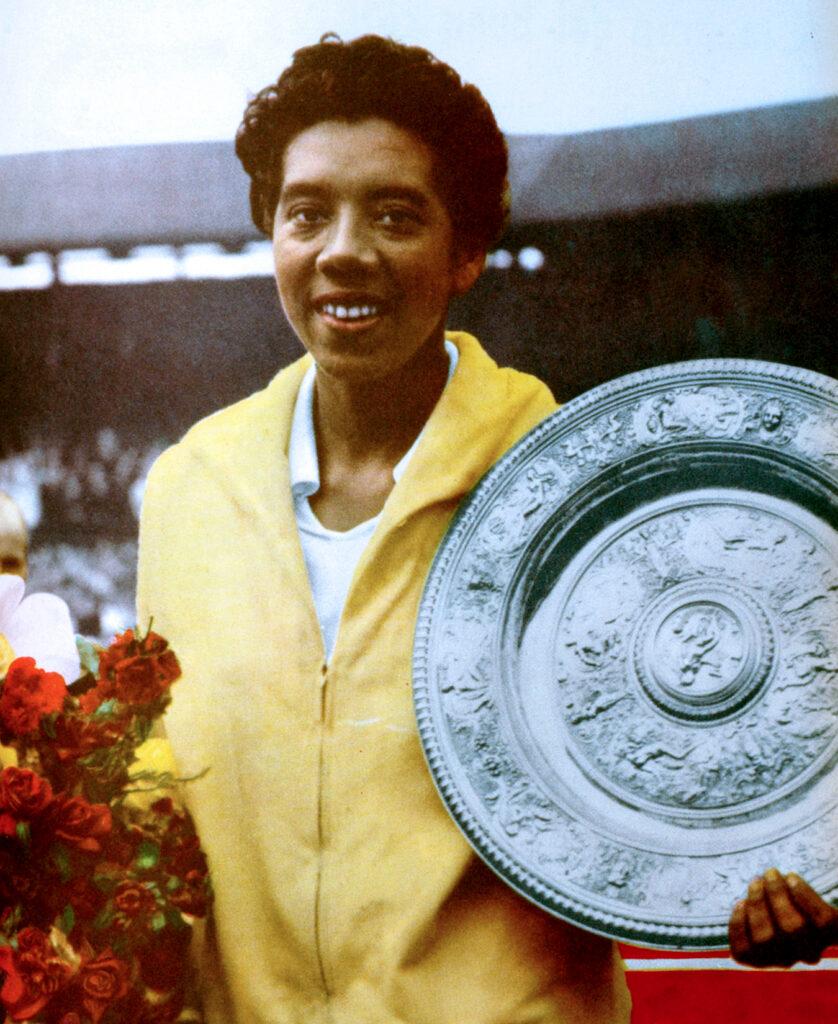
Gibson ranked number one in 1957 at Wimbledon, known as the “world championship of tennis.” She defeated Darlene Hard, and became the first Black woman or man champion in the tournament’s 80-year history, noted the Free Encyclopedia.
In her career, Gibson won 11 Grand Slam events. In 1957 and 1958, the Associated Press crowned her Female Athlete of the Year; she received more than 80% of the deciding votes.
Gibson played aggressive tennis, her powerful serve manipulated opponents. Her tennis serve enabled her to score easy points; she liked to play the net scoring her own points instead of forcing opponents into errors, stated Wikipedia.
Afterwards Gibson returned home to New York, she became second Black person to Jesse Owens honored with a ticker tape parade.
Gibson’s legacy lives on in professional tournaments, schools yards, and recreational parks. When a Black or Hispanic child picks up a tennis racket for the first time, Gibson has touched their life, noted Wikipedia.
“I am honored to have followed in such great footsteps,” wrote Venus Williams. “Her accomplishments set the stage for my success, and through players like myself and Serena…her legacy will lives on.”