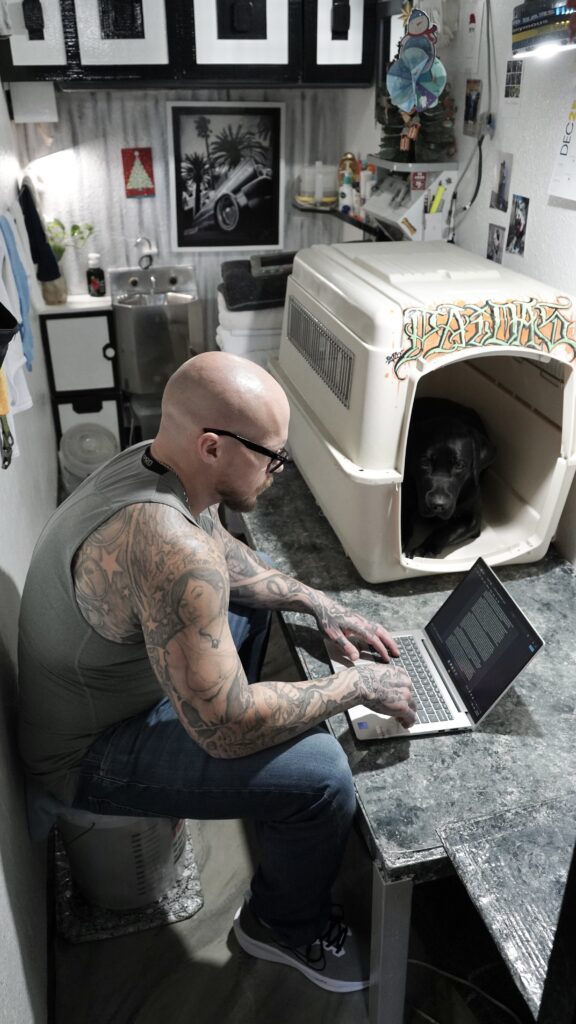
The Animals Welfare Act regulates confined spaces for animals, but there is no such protection when it comes to incarcerated people.
The Animal Welfare Act has set requirements in the confinement of dogs, while they are transported, and under the supervision of breeders, according to the U.S. Department of Agriculture.
San Quentin resident Maurice Bradshaw, 45, has been at SQ for three years and has served time at Sierra Conservation Center, a CDCR fire camp. He said the dogs in the canine training program at SCC were treated better than incarcerated people.
“Dogs ate better and their all-around treatment was better,” Bradshaw said. “I would get a write up (Rules Violation Report) for mishandling a puppy in the dog program before a conflict with another resident.”
Confinement is defined as being restricted from movement, limiting the mobility of someone or something in order to be controlled, according to Webster’s New World Dictionary.
The AWA requires a certain amount of floor space for dogs, which needs to meet or guidelines. In order to insure those mandates are followed, AWA gives two basic steps for dog handlers to follow.
Step 1: Measure the length of the dog (in inches) from the tip of its nose to the base of its tail, and then add 6 inches to this number. Measure the dog while standing in a normal position or while lying flat on its side.
Step 2: Take the total number in Step 1 and square it. This will result to the dog’s minimum floor space in square inches. To convert the number to square feet, divide the total number in square inches by 144.
The AWA regulates floor space for animals, but who regulates floor space for the incarcerated?
San Quentin and Folsom State Prison are two of California’s oldest prisons. Each cell is double occupancy though they were originally designed for one person.
In an effort to address mass incarceration in the 1990s and early 2000s, CDCR increased its capacity by double bunking cells, and placing bunks in dayrooms and gymnasiums, according to Cal Matters.
As a result of litigation in Coleman and Plata in the 2000s, the federal District Court ordered CDCR to reduce its population to 137.5%. Today the department’s population stands at 120%. Federal oversight addressed the overcrowding but not the double-cell occupancy, noted Cal Matters.
At San Quentin Rehabilitation Center the floor space in cells is 46 sq. ft. The American Correctional Association recommends 92 sq. ft. of floor space in order for two people to live in one cell, according to the 2024 Reimagining San Quentin Report.
If a person divides the 46 sq. ft. of floor space by the two people occupying the cell, it would come to the 23 sq. ft. of open space per occupant, well below the recommendations.
In Bergen, Norway, correctional officials mandate 137.5 sq. ft. for single cell occupancy, and a privacy partition between the bed and toilet, noted the report.
Armenia Cudjo, 68, said he has been in SQ’s general population for three years, after spending more than 25 years on the prison’s Death Row.
Cudjo said he’s mobility impaired, currently battling cancer, and dealing with epilepsy (seizures). He has been a part of Americans with Disabilities Act accommodations for most of his incarceration.
“It would be good to have an assisted railing inside the cell,” Cudjo said. “I use the sink and the edges of the extra bunk to stabilize my mobility throughout the cell.”
On February 20, 2025, California Assemblyman Damon Connolly (D-San Rafael) introduced Assembly Bill 1140. This legislation aims to coincide with recommendations of the ACA that would bring single-cell living to four adult correctional facilities.
The bill would require 10% of each facility to be single-cell occupancy by January 2027. The pilot program is on a volunteer basis, and the Secretary of the CDCR will conduct its oversight.