By Kevin D. Sawyer, Editor-in-Chief
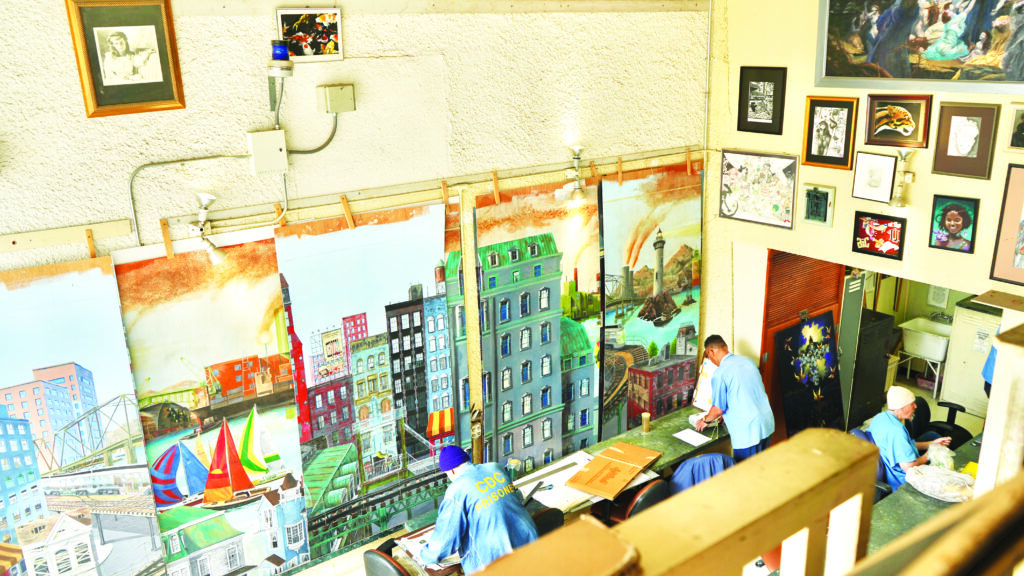
The Arts in Corrections program at San Quentin Rehabilitation Center was notified that its funding through the William James Association would not be made available for at least one year.
Financial support for AIC at San Quentin was cut short when the California Arts Council rejected a WJA proposal for funding.
“They literally told us in January there’s no more funding coming in,” said Art Hazelwood, an instructor employed by WJA. He teaches drawing and runs the open studio on Saturday mornings. “Last year when they cut funding, that cut my class in half.”
Scott McKinstry has been incarcerated at San Quentin since 2004. He is an artist and is a well-established participant in the AIC program. “It’s already affecting the program,” he said, because it will limit teachers.
WJA’s mission, according to its website, states that it “…promotes work service in the arts, environment, education, and community development. Our work has been primarily centered around transformative arts experiences in nontraditional settings, serving men and women in and after prison and high-risk youth. Acting on the conviction that the fine arts enrich, heal and unite communities, the William James Association has brought exceptional artists into prisons and jails throughout California and other states since 1977.”
Annually, more than 2500 individuals benefit from WJA supported funding, according to its website. Fifty-three staff and teaching artists are employed, serving 11 counties, and “75% of its funds are allocated to support WJA art workshops.”
Carol Newborg has been teaching art through AIC programs more than 40 years; 15 of those years have been at San Quentin. In a letter for this story, she wrote about being a witness to “…so many people [who] find themselves through the arts, be it drawing, painting, writing, music or acting, that I know the arts can help support deep and permanent change and rehabilitation for many.”
Participants — some named, and some anonymous — in AIC’s creative writing program submitted WJA written testimonials to express what that program means to them. Their words, however, were not considered.
“For me, writing fiction helps me see the world through the eyes of others — the eyes of the characters I create,” Todd Winkler wrote. “Since being part of the WJA creative writing program, I’ve created characters who are fleeing oppression, characters suffering various forms of discrimination, and characters victimized by crime. Creating these pieces helps me develop empathy for others.”
“The creative writing workshop made me hungry to tell my stories,” one participant wrote. “I wonder what my prison experience would have been if I had not found creative writing; and I shudder when left to imagine what time I would be wasting on Wednesday nights in the absence of the program.”
“Creative writing has helped me expand my self-expression,” another participant wrote. “The group structure allows me to learn how to accept critical feedback and incorporate it into my writing. It inherently helps me to refine myself while creating a space to genuinely consider other people’s idea of what a story should look like.”
James Bottomley described himself as a “neophyte fiction writer” when he joined creative writing in 2014. He paroled from San Quentin last year in mid-February. “I am pleased to say that the writers group was one of the most rewarding experiences in my life,” he wrote.
“Each story reflects the strength of creative expression as a tool for growth, resilience, and reimagining what’s possible,” WJA’s website states. “Through paintings, poems, and shared experiences, these individuals remind us that transformation begins with opportunity, creativity, care, and extending humanity.”
In 1977, William James Association started the first in-prison arts program. It spawned Arts in Corrections after the success of a fine arts pilot project established by Eloise Smith at California Medical Facility in Vacaville, Calif., and became a national model for prison arts programs.
“The long and successful history of Arts in Corrections, studied by many from around the world, and statistically proven to significantly lower recidivism by California Department of Corrections and Rehabilitation’s own studies, shows that the types of programs offered by the William James Association are too important to drop at San Quentin,” Newborg wrote.
“When funding gets cut, it isn’t just a program that disappears; it’s a corridor of transformation,” Watani Stiner wrote in a letter for this story. “William James Association didn’t ‘teach’ me writing so much as it returned me to myself. In a place designed to erase your name and replace it with a number, that classroom handed me a pen like a set of keys and said: unlock the human. We weren’t doing homework, we were doing witness. We were practicing freedom in sentences, building a bridge out of concrete and time. And let me be plain: the cheapest thing this society can do is pay for cages. What it can’t afford is the cost of souls left untended.”
According to WJA literature, the first time its funding was eliminated was in 2003, and again in 2010 when state budget cuts were made. At the time, funding from private sources became the stop-gap for WJA at San Quentin.
The state legislature funds the California Arts Council which provides grant funding to Arts in Corrections through the William James Association.
When WJA was funded by CAC it was a good way to keep it going, said Hazelwood. “Some years CAC says great,” he added, but “It’s not a good funding solution to fund arts programs [in prison]. People are holding on hoping [WJA] will get funded.”