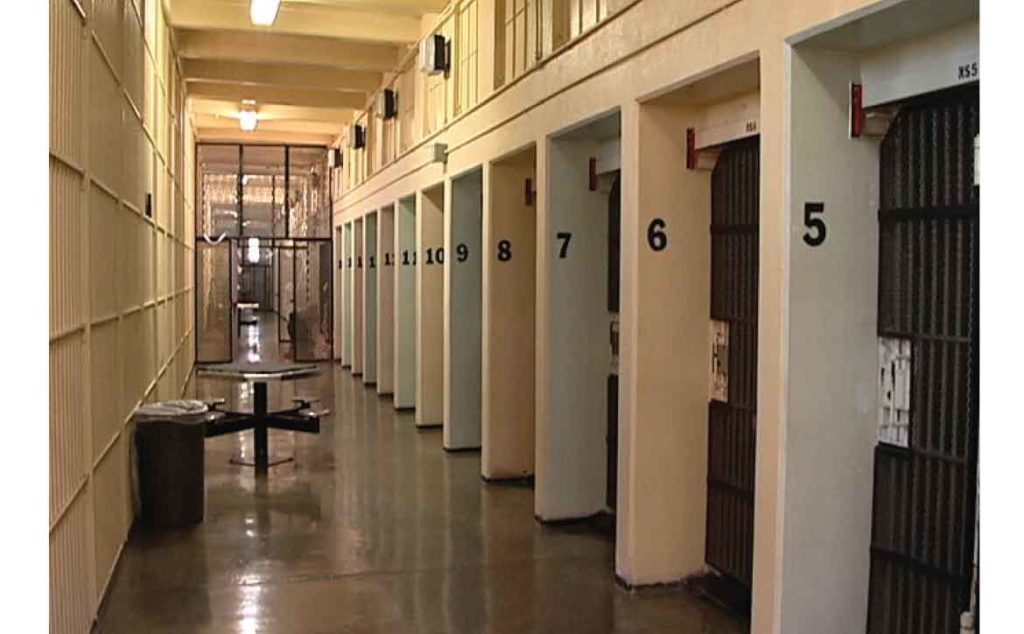
At one time, Jerry “Mo Mo” Rodriguez, 52, was one of more than 700+ men on San Quentin’s infamous Death Row. Incarcerated since 1994, he spent 25 years alone in a cell. Today, he is a Peer Specialist worker on the permanent work crew at the California Health Care Facility in Stockton, California.
In a series of one-on-one interviews, Rodriguez expressed appreciation for his removal from “The Row,” the name he and others with death sentences have called their old home inside San Quentin’s East Block.
“The one person I want to thank for all of this is [Gov.] Gavin Newsom,” said Rodriguez. “We’re here [at CHCF] to make the program work. We have the opportunity to help others.”
In 2019, Gov. Newsom placed a moratorium on executions. “[The] death penalty system has been, by all measures, a failure,” Gov. Newsom said at the time. “[It] has discriminated against defendants who are mentally ill, Black and brown, or can’t afford expensive legal representation,” he continued.
“I’m still condemned,” said Rodriguez. Most days he participated in self-help groups or was busy assisting inmate-patients. As a Peer Support Specialist worker, Rodriguez made it his mission to speak with them. “Sometimes the simple act of acknowledging someone exists” [is a blessing],” he said. “Saying ‘good morning’ may mean the world. It’s something we take for granted — the simple act of kindness.”
Rodriguez recalled his father urging him not to let prison fundamentally change who he was when he was first incarcerated. In honoring that sentiment, he has always held on to hope. “I never fully embraced that whole ‘you’re a Death Row inmate’ [despair], because my innate sense of who I am wouldn’t allow it.”
The transition from The Row to CHCF was no cakewalk, though. Before Rodriguez arrived at CHCF, he was sent to California State Prison, Sacramento. “It was real depressing,” he said. “I was glad I wasn’t staying there.” Rodriguez said CSP-Sac reminded him of San Quentin’s Adjustment Center (administrative segregation) in 1996, a place he thought he would stay indefinitely.
When Rodriguez arrived at CHCF’s Receiving & Release building in 2024, his handcuffs, waist chains, and leg shackles were removed. For the first time in decades, he was allowed to walk in prison unrestrained, without a correctional officer to escort him, and with fewer restrictions.
“In total, approximately 58 people were removed from death row last year….a nearly 10% single-year decrease in the population of the largest death row in the country,” the Death Penalty Information Center reported. “As a result, California’s death row population fell below 600 for the first time in 25 years.”
In 2024, California courts reduced sentences of death for at least 45 people on The Row, according to the DPIC. In Santa Clara County, Rodriguez’s county of commitment, District Attorney Jeff Rosen has used his power under state law to recall sentences in some capital punishment cases “in the interest of justice,” it was reported. Rosen said clearing the prisoners from Death Row who are from Santa Clara County was his “second and final step” in that goal.
Rodriguez said CHCF is a community of a different type. “Here, it’s like, this is how it’s supposed to be,” he said, contrasting it to the “the beast” of the system that tried to dehumanize him “like the slaves.”
“To be able to move around like a normal human being, it didn’t take long for me to realize they [CDCR] sent me to a transitional home.”
Rodriguez’s transition did cause him a little uneasiness from the “anxiety” of having to share a cell with a cellmate for the first time, and “sensory overload” from so many people — other inmates and CHCF staff — and the relative freedom of their physical movements. “There are people who work here that make a difference,” he said.
Rodriguez used the words “foreign” and “abnormal” to describe how he viewed all forms of incarceration. But he also acknowledged his past, and what led to his death sentence.
“When your crime is so horrific, you can’t make direct amends to people,” said Rodriguez. Now he’s been given the opportunity to make amends by serving the health care facility. “You get a form of healing from helping other people.”
Rodriguez said he enjoyed being able to assist others, because to perform a human act he found rewarding — acts he calls “living amends.”
There was one person Rodriguez said he would like to have dinner with, it’s the governor. “My main goal — I want to thank Gov. Newsom,” he said, not just for himself but for others, too. “Newsom deserves his props.”