Are you incarcerated and want to share your prison experience with the world? Well, Humans of San Quentin is a nonprofit that does just that.
HoSQ publishes stories about lived experiences, artwork that highlights individualized creativity, poetry about life and relationships, food experienced before prison, and recipes for cooking in prison.
Resident Curtys Taylor said that for him the most impactful part of being on HoSQ’s community engagement team is the responses he receives from readers in society, who see those incarcerated as humans, and not their crime.
“Telling our stories aren’t always easy because we have victims to think about,” said Taylor. “Humans of San Quentin have given us the opportunity to tell our stories for all those who are willing to listen.”
Sharing your experience helps to change the narrative and the stigma placed on people in prison. Whether it is a personal memory, poem, art, or food related story, it is important to include the voice of people excluded from those public conversations about humanity.
Resident Treavion Early said that his focus is to do things that impact positive change in his community.
“Being a part of Humans of San Quentin was a meaningful experience. I was able to be more comfortable when sharing my story. I am no longer harming my community. Now I’m giving back to my community,” said Early.
The program is open to anyone who wants to share his or her lived experience. You do not need to write long stories that explain a bunch of details. You do not need to write well because HoSQ has dedicated interns who love to read and edit your stories.
“I have always been interested in the criminal justice system,” said Eva, an intern with HoSQ. “It is so cool to be here with the humans whose stories I have read and pictures I have seen.”
HoSQ publishes stories on their website, Twitter, Instagram, and Facebook accounts to show incarcerated persons’ humanity, but there are three exceptions: no nudity, violence, or gang art.
Resident Darius Poole said that being at San Quentin allows him to give back to his community. He said he was excited to learn that people in society still hear his voice even though he is in prison.
“I feel like being posted online helps me feel like a human,” said Poole.
By sharing your experience, you can help educate people in society and bring awareness to the humans locked inside prisons, some for decades at a time.
Each human in prison has a lived experience, and by reflecting on that experience you can change the path of someone traveling that same journey. Sharing your experience can provide other men and women with insight about living in prison, and for you, the writer, it could be a tool for processing painful experiences.
Stephen Embrey lost his daughter three weeks after dancing with her at a father/daughter dance, the first one held at San Quentin where resident fathers attended a prom with their daughter. He said that was hard for him to talk about his loss and his situation, but HoSQ gave him a chance to express what he needed to say.
“Humans of San Quentin allowed me to speak up about my loss and I just had to write about it because I wasn’t able to talk about it,” said Embrey. “I appreciate them putting my voice and my story out there to show how much I love and care about my daughter.”


The community that HoSQ provides to people in detention facilities in and outside of the U.S. cultivates connections with other incarcerated people and outside communities. These connections help to develop compassion and empathy for people experiencing similar situations.
Jose Lopez said he joined HoSQ after seeing a flyer hanging around the prison. Lopez said that he made bad choices as a young man, but that today, after joining HoSQ, he has become a different person.
“When I saw the flyer to write about face tattoos, I felt like I could relate. When I was younger, I was a lost and selfish kid who joined a gang. I thought tattoos were a badge of honor,” said Lopez. “In prison, there were certain jobs I couldn’t get because I had tattoos on my face.”
The stories shared by the incarcerated men and women change attitudes and break down those false belief systems that tend to separate humans from one another. Through shared experiences, anybody can build healthier emotional connections with the outside community and inspire others.
Diane Kahn was inspired to start HoSQ after hearing about the storytelling project Humans of New York. HoNY was founded in 2010 by Brian Staton for men and women incarcerated in New York. Staton, who interviewed people around the world, concluded that “writing will be more compelling when it is told through the eyes of a relationship,” according to Kahn.
In 2018, Kahn met with James King, who was an incarcerated writer at SQ, to discuss her passion for sharing incarcerated voices with the world. She was encouraged by King to meet with Juan Haines, who at the time was the senior editor for SQNews, because Haines too had a passion for projecting those unheard voices from behind prison walls to the outside world.
Residents involved in HoSQ said the program is different from other writing programs at SQ because it allows them to share their authentic selves.
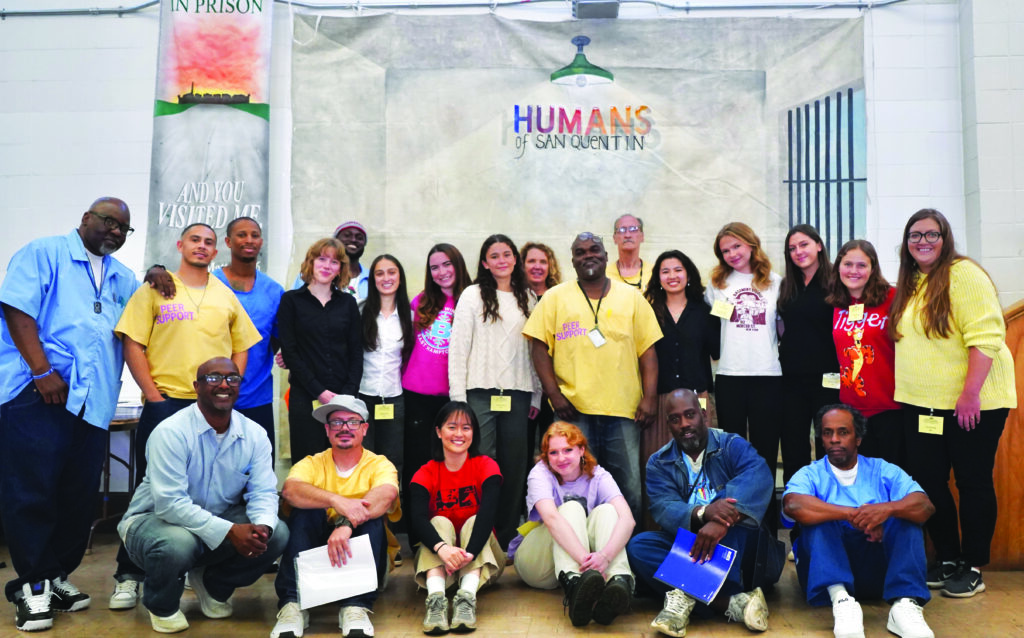
HoSQ showed their appreciation for its members doing time at San Quentin by hosting an appreciation celebration. More than 60 contributors attended the festivities, which included performances from both the resident Aztec group and the resident Native Hawaiian religious group; both groups’ performers shared the history of their culture through dance numbers. Also performing was resident Matthew Sheppard, who shut down hecklers wanting to include President Donald Trump into his comedic routine. He stuck to skits about prison food and humility after connecting his parents’ substance abuse to subtle addictions to comfort foods like potato chips and peanuts.
Alongside residents, the 30 volunteers who help edit and post the incarcerated voices to the social media platforms mingled with residents who enjoyed pizza and cake during the event.
Kahn said that over the course of four months she has been organizing the HoSQ content to show up on Edovo, an education application on the tablets that were distributed to incarcerated people in prisons. HoSQ is in 190 facilities in and outside of the U.S. and Kahn said that the credit goes to the incarcerated people willing to share their vulnerability and their authentic selves with the world.
“We wouldn’t be there if it wasn’t for the stories you guys share,” said Kahn.