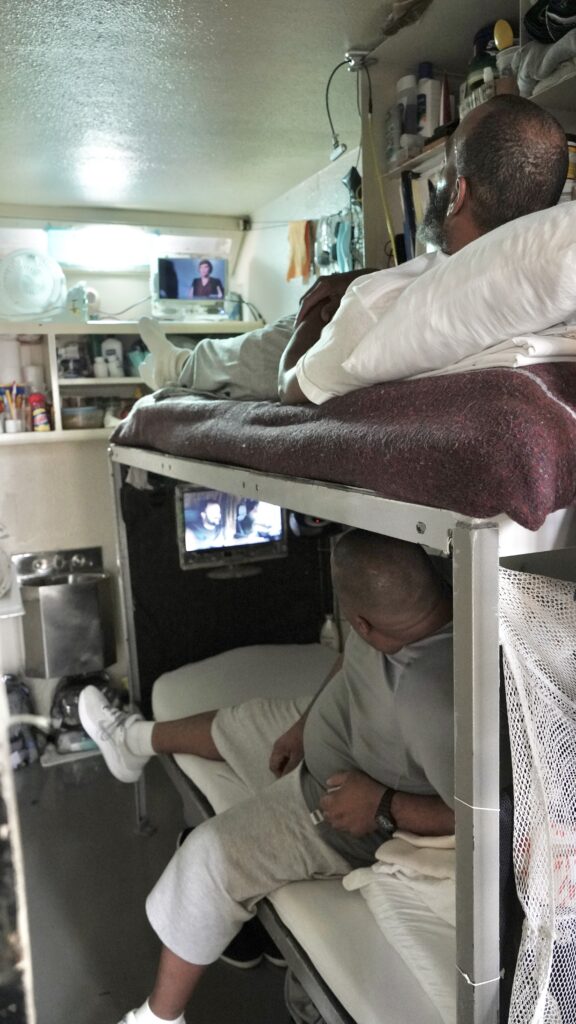
San Quentin Rehabilitation Center stands on the front lines of providing safer living conditions for incarcerated people by providing more widespread single-cell occupancy.
In January, the SQRC community heard construction noises and witnessed loads of barbed wire, steel isolation cells, and debris hauled away from the prison’s former administrative segregation Carson unit of South Block — which was disbanded in 2023 — during renovations.
“With another prison closing soon, there was a big push to get this unit open,” said South Block Lt. Campbell.
Campbell said the effort to repurpose Carson was twofold: it expanded on plans to provide more single cells for the general population and made space for the potential intake of incarcerated people.
SQRC’s move toward providing more single-cell housing units is in line with what some California policy makers and prison officials said is in the interest of incarcerated people, prison staff, and public safety, according to an article in CalMatters.
California’s incarcerated population has declined from 173,000 people in 2006 to under 90,000 today. Many agree it is time to rethink potentially harmful double occupancy housing situations inside prisons.
Through Gov. Gavin Newsom’s term, changes to resentencing and parole eligibility have helped to release thousands of incarcerated people. Newsom has shut down four prisons, with an additional closure currently in the works.
The governor’s administration stated that the only reliable way to bring down corrections spending is to close prisons. It is estimated that with each prison closed, California will save $150 million a year.
San Francisco District Attorney Brooke Jenkins has visited SQRC numerous times over the last few years and spoken with residents about cellmate-on-cellmate violence, along with the stress that comes with sharing a cell.
“We want people to have the opportunity to return back to our community, and we want them to do that in the healthiest manner,” said Jenkins. “You can’t do that if you’re in an environment that causes chaos and stress, or you can’t sleep, you’re having confrontations, you’re irritable because you’re sleeping with one eye open.”
In 2025, Jenkins worked with Assemblymember Damon Connolly (D-San Rafael) to draft Assembly Bill 1140 that proposes establishing single-cell pilot programs at four California prisons.
Although the bill did not make it to Gov. Newsom, it advanced in the California Legislature and is expected to return in 2026.
The bill states, “To properly be able to engage in rehabilitation programming, incarcerated persons must be able to sleep without fear of physical harm.”
Connolly said that single-cell housing units additionally promote safer work environments for corrections officers and staff. “It fits in, in my view, with the larger objectives that the governor and many of us have pursued,” he said.
During mass incarceration efforts in the 1990s and early 2000s, the corrections department welded and bolted extra bunk beds into almost every single-person cell across the state. They also placed bunk beds into spaces never intended for housing, like hallways, gyms, and even stairwells.
After decades of overcrowding people at 200% capacity, prison rights litigation eventually forced the system to address the issue. Current housing rates across all 31 state prisons stand at about 120% of designed capacity, noted the CalMatters article.
Since mass incarceration numbers have dropped, the California Correctional Peace Officers Association has lobbied against further prison closures and, in general, supported emphasis on rehabilitation for incarcerated persons.
“The threat of violence and tension in shared cells…fosters conflicts amongst cellmates, necessitating intervention from correctional officers, who place themselves in jeopardy, thereby escalating the overall parties involved,” the CCPOA said in a support letter to Connolly.
Addressing the SQRC community at a February town hall meeting, Warden Chance Andes said he was “working toward” providing residents with more single-cell housing by this spring.
SQRC’s Carson unit opened in February, adding 210 single-occupancy cells to the 238 already occupied by residents in the neighboring Donnor unit.
Warden Andes said construction is currently underway inside the vacated East Block building, formerly known as Death Row. He said repurposing the building will provide another 500 single-occupancy cells to the general population.
Since the completion of Carson, department heads have pushed work crews to finish repairing East Block as soon as possible, said SQRC resident and plant operations employee Walter Sprafka.
Housed in Donnor unit, Sprafka said the peace of mind that comes with having a cell to himself goes beyond privacy and safety concerns; it means not having to worry about a possible rules violation because of what a cellmate did or brought into the cell.
If an officer finds a weapon, drugs, or a cellphone inside a cell, it is common practice to give both cellmates a rules violation.
“Getting a write-up for something you didn’t do is definitely possible when you have a cellie,” said Sprafka. “Once you get a disciplinary infraction, regardless of whose fault, it stays on your permanent record.”
Since residing in Donnor, Sprafka said the anxiety that comes with having a cellmate has gone away. Now he can better concentrate on his rehabilitation efforts and prepare to meet with the parole board.
Two ways Warden Andes is working toward his goal of making San Quentin Rehabilitation Center a benchmark for other prisons to follow are by revamping buildings to provide more single-occupancy cells for residents and opening new education buildings.
“I would love to spread our model across the state,” Andes said. “Ours is very unique — the location, the atmosphere — and what we are building here give us the opportunity to set an example so others can move forward and develop their own vision.”
CORRECTION: In a previous version of this article, we reported that “San Quentin and Folsom prisons were originally designed as one-bunk cells.” That statement was presumptive and not grounded in evidence. SQNews does not have information about the intentions of the designers of the cells at San Quentin and Folsom.