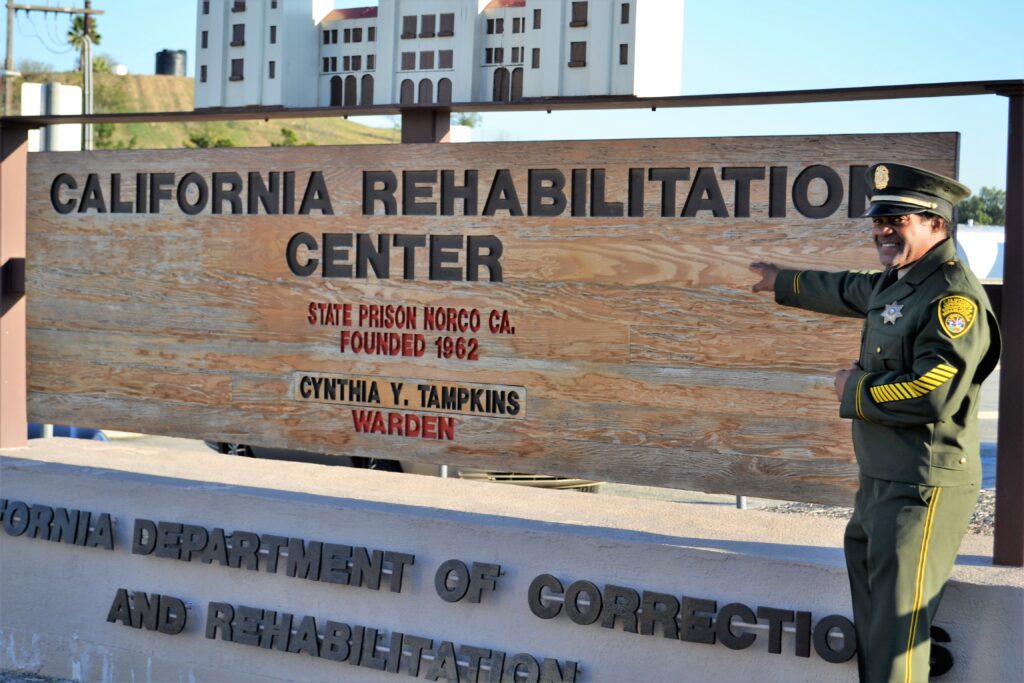
Closure of the California Rehabilitation Center in Riverside County in 2026 will save $150 million annually for the state, but will displace over 1,200 employees.
Some city officials celebrate the announcement, hoping that closing the prison in Norco, California, will restore the property to its former glory, once a luxurious resort location, according to a Press-Enterprise article.
The California Correctional Peace Officers Association has a different take on the notice and alleges the closure will have serious and disruptive consequences.
“It affects not only…officers and their families but also the broader Riverside County community, which has relied on the stability of these jobs for decades,” CCPOA spokesman Nathan Ballard wrote.
Ballard added that the results of this closure should not go unnoticed and will force transfers, fracture families, and, in many cases, end some notable public safety careers.
Brian Charest, Phil Peng, and Tina Ogata are outside volunteers who helped establish the Born to Run Running Club for residents in the Norco facility in 2024.
According to Peng, a retired Los Angeles Court commissioner, they teach more than fitness and nutrition in the program; they also focus on the power that results when an individual develops a growth mindset.
Charest, a professor at the University of Redlands, said the closure will have a direct impact on the CRC community who worked hard to establish a positive rehabilitative program.
“Running can be a vehicle for all kinds of change within a person, both physical and mental,” Charest said.
Volunteer Ogata said closing the prison will hinder residents from learning valuable life skills to make a successful transition back into society.
“Each week participants spend one hour in the classroom before spending one hour out on the track,” Ogata said.
Peng said the membership of the club has doubled since its inaugural event, thanks to the support of the Norco Community Resource Management team and residents.
California Department of Corrections and Rehabilitation officials stated that they are making every effort to mitigate the impact on volunteers, staff, and the population throughout the prison’s inactivation process.
“The state will provide support to the affected local community and workforce with an economic resiliency plan,” CDCR noted.
California state prisons house around 91,000 inmates in 31 prisons this year, a 47% drop in population from a 2006 count of 173,000. This is the lowest level since the late 1980s, noted the article.
In 2012, a court-appointed receiver looking at CRC’s health care estimated a cost of $1.4 billion to repair the buildings at CRC. The 2012-2013 state budget then proposed to close the prison by 2016.
In 2015, Sen. Loni Hancock, D-Oakland, informed CDCR that CRC was full of rats and cockroaches and was missing floor tiles. More than a decade later, the prison’s closure plan will finally come to fruition in 2026.
According to Press-Enterprise, this property has a fascinating history that dates back to the grand opening of a luxury hotel in 1928.
The establishment provided hot mineral baths and an 18-hole golf course to guests that included Buster Keaton, Babe Ruth, Will Rogers, Charlie Chaplin, and Clark Gable. Amelia Earhart also used the hotel’s private airstrip to practice takeoffs and landings.
President Franklin D. Roosevelt converted the one-time resort into a Navy hospital in 1941, according to the CDCR website.
The hospital became CRC when it was donated to the state and turned into a drug rehabilitation center. In 1957, prisoners moved in alongside patients.
Riverside County Sheriff Chad Bianco said he is not a fan of the CRC closure and sent a statement from his gubernatorial campaign.
“Gavin Newsom’s soft-on-crime policies continue to put criminals ahead of victims. Shutting down another state prison…isn’t reform, it’s reckless,” noted Bianco.