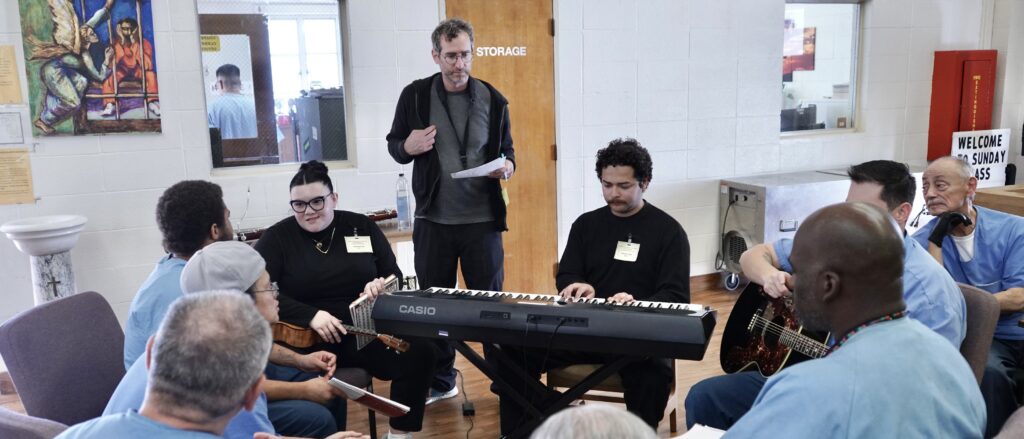
Silky, smooth falsettos and blaring horns brought musicians together in a weeklong Musicambia workshop.
Musicambia held its annual workshop at San Quentin, where seasoned artists, accomplished music students, and incarcerated people bonded over songwriting and the shared appreciation for all things music. The workshop culminated with a two-hour concert where participants performed 12 original songs created throughout the week. The musical genres ranged from R&B, jazz, to rock & roll.
“I love being able to work with a full scale band and to share my lyrics. It’s a great feeling being seen and heard in a healthy way,” said San Quentin resident Douglas Yim, who helped write lyrics to one of the original songs. Yim said he was inspired by the visiting musicians and loved the fact that everyone learned from each other during the process.
This year’s workshop was attended by students from the San Francisco Conservatory of Music. Among the group were talented trumpet and trombone players, drummers, bass players, keyboardists, and vocalists. The students spent a week connecting with incarcerated artists, assisting with songwriting and providing useful tips with various instruments. They were invaluable contributors to the songs created during the workshop.
“I would definitely do this again,” said Trissha Monterola, a vocalist and student at the Conservatory of Music, who works as a sound effects specialist on video games. She said the workshop afforded her the opportunity to connect with and learn from the incarcerated people who attended.
“Music is about connection. It is a medium that allows people to understand themselves and others,” said Monterola.
Founded in 2013 by musician and composer Nathan Schram, Musicambia brings music into prisons to help incarcerated people “build community, creativity, and personal growth,” according to the language on the program’s website. The workshop gave incarcerated musicians the chance to build genuine connections, and share their stories through the music they created.
“Music has allowed me to vent my emotions and express myself. I’m often considered an oddball because I’m from another country, so I stay to myself a lot and pour into my music,” said SQ resident Michael Mackey, who started rapping at the age of 13. After immigrating to America from Haiti, Mackey said he fell in love with Hip Hop culture and music after seeing the group and rap artists Digital Underground and Tupac Shakur perform for the first time.
“Music is universal. It is how I was able to bridge the gap between me and my new environment,” said Mackey. Mackey credits music for not only increasing his education and making him a better communicator, but with molding him in a way that enabled him to better connect with those around him.
More than the creation of songs, Musicambia showed music’s unique ability to bring together people from different backgrounds, communities, and walks of life. Through their love for the art, seasoned professionals like Judith Hill rocked it out with students and aspiring artists, and people with little to no knowledge of incarceration shared their skills with men who have spent years in prison.
“Music has the ability to cross social borders. The people from Musicambia come in and work with us at our lowest, and they use music to help us connect and get to our highest,” said SQ resident Oscar Wilde, who participated in the workshop for his second year and is looking to volunteer with the program after his release.
Musicambia revealed that rhythm and music notes are not pigeonholed into one group or category, but instead can be shared in numerous genres by anyone looking to build a bridge of connection.
“Music shouldn’t be a commodity. It should be accessible to everyone and used to learn about different walks of life while helping people find themselves,” said Monterola.