San Quentin residents need earplugs to tolerate ear-damaging announcements
By Terrell J. Marshall, Staff Writer
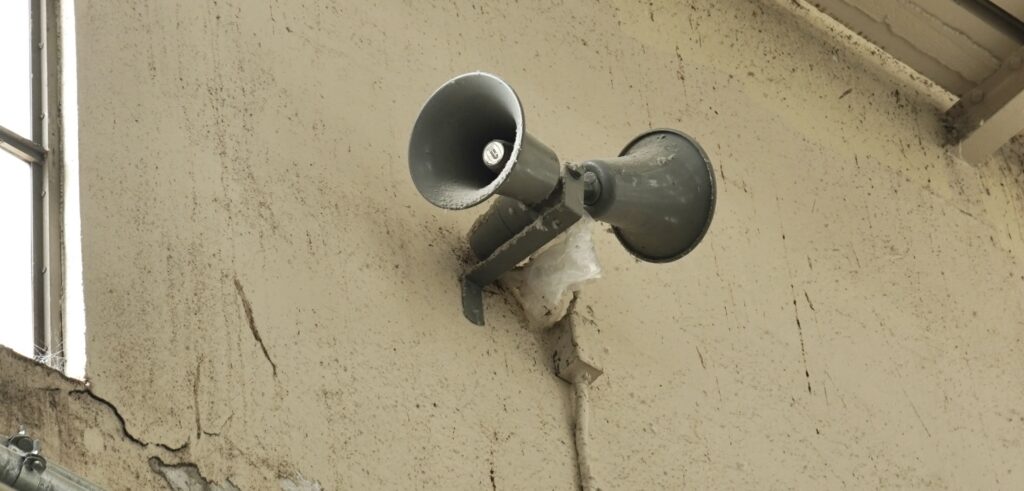
The loud public address system used to make announcements inside the housing units at San Quentin Rehabilitation Center is taking a toll on residents and causing health concerns.
According to Chris Berdik’s research in Discovery Magazine, loud noise has the power to cause permanent and irreparable hearing loss, which can negatively affect a person’s mental health.
“Most officers use the PA system properly,” said SQRC resident Robert Gomez, 56. “But some of them blast the volume all day long and start yelling as soon as they get here.”
On average, residents housed at SQ hear more than 80 announcements daily. Correctional officers use the facility’s PA systems to inform incarcerated people of scheduled unlocks, when to receive medication, attend appointments, or to get on the ground during an alarm.
Some residents are worried that the cumulative attacks on their ear drums by the loud noise coming from the PA speakers are negatively impacting their health. Berdik’s research about hearing loss validates their concerns.
Berdik found that sounds are essentially waves of energy that trigger cascades of molecular collisions inside the eardrum. Loud sound waves damage the inner ear, causing hearing loss.
The Centers for Disease Control and Prevention reported that more than 40 million American adults have noise-induced hearing loss, a number that could exceed 73 million by 2060.
According to resident Stuart Clarke, 69, some days there is no escaping the barrage of noise coming from the facility’s PA system.
“Some officers claim we can’t hear them as justification for making such loud announcements,” said Clarke. “It’s not that we can’t hear them, it’s that we can’t understand them because they don’t enunciate properly when they are yelling.”
Sound is measured in decibels. The National Institute for Occupational Safety and Health suggests a limit of 85 decibels of exposure over eight hours. Meanwhile, the Environmental Protection Agency recommends that people cap their exposure at 70 decibels — comparable to the sound of a dishwasher — over the course of 24 hours.
Berdik’s research revealed that sound energy bends the hair cells that line the components making up the inner ear, sending electrical signals to the brain through the auditory nerve. He cautions that loud sounds do not just bend hair cells, they break them, destroying their connections to the auditory nerve.
Berdik added that eventually the battering caused by higher decibels will kill off entire cells, disrupting the flow of neural messages to the brain.
“Your ears don’t care if the decibels come from your job, your local bar, or your power tool. They don’t care whether the music blasting from your ear buds is rock, country, or hip-hop,” said Berdik. “If the sound is loud enough, it will cause damage.”
His advice to those exposed to loud noise is to wear protection; otherwise, there is danger of losing part of their sonic world forever.
A meta-analysis in Berdik’s research found hearing loss raised the risk of depression by 50%. It also found that people with mild hearing loss doubled their chance of developing dementia.
Housed directly across from a PA speaker, resident Marcus Gallegos, 59, suffers from hearing loss and recently received a hearing aid. Ironically, he cannot wear the device indoors due to the volume of the PA system.
“Sometimes that damn speaker is so loud it hurts my ears even when I’m not wearing my hearing aid,” said Gallegos.
Gallegos suggested that placing an additional speaker closer to the officer station might help them better understand the negative impact of the PA system’s volume first-hand.
Audiologist Deanna Meinke is a professor at University of Northern Colorado and co-director of the organization Dangerous Decibels. She said that noise-induced hearing loss is irreversible and the only effective antidote is prevention.
Meinke said that earplugs are a cheap and easy way for people to protect their ears, and that those exposed to load noise would be crazy not to use them.
“Hearing, like our other senses, connects us to the world, and severing those connections cuts deep,” said Meinke.
San Quentin offers disposable foam earplugs to residents concerned with load noise.