By Kevin D. Sawyer
Kevin R. Schrubb, 64, arrived in prison with a sentence of 1,010 years and 19 life terms. He was addicted to drugs and robbed banks to support his habit until California’s Three Strikes Law caught up with him.
After 23 years of incarceration, Schrubb faced his first appearance before the Board of Parole Hearings. Arguably, he was better prepared than most who arrived in prison with such a bleak outlook on his future. Because of his hard work and rehabilitation, he was able to pivot and turn his life around.
Warden Chance Andes at San Quentin Rehabilitation Center referred Schrubb’s name to the secretary of the California Department of Corrections and Rehabilitation for a recall of sentence. Ten days later, Schrubb received a commutation of his sentence from Gov. Gavin Newsom.
“I still don’t feel comfortable saying I earned all this great stuff, like support from staff, the governor, the warden, and free people, all of whom say I earned this,” said Schrubb. “This is the place [SQRC] God has chosen to bless me.”
During Schrubb’s rehabilitative journey, he immersed himself in multiple groups and self-help programs to address the underlying trauma that had once been the catalyst for all of his criminal undertakings.
“I have like 35 groups,” said Schrubb. Some of those were California Re-entry Institute, Guiding Rage Into Power, No More Tears, and others.
“Those are the ones that really had an impact on me,” said Schrubb. “They informed me with first-hand experience of what [people] went through as victims of criminal acts. It changed my outlook on the harm, pain, and suffering I’ve caused to my victims. As a result, I vowed to never do harm to anyone else.”
Harm, pain and trauma visited Schrubb early in life, and it continued while he was in prison.
“When I was five years old, my mother left me and my younger sister with one of her eight siblings who was in a worse position to take on two more mouths to feed,” Schrubb wrote in a 2021 letter. He described an older cousin as his “first bully” who later molested his sister.
A child of the 1960s, Schrubb was raised in the spare-the-rod-spoil-the-child generation. “Beatings with extension cords for the slightest offense were commonplace,” he wrote. By the time he returned to live with his mother, he said she used verbal abuse to replace his aunt’s physical abuse.
“I couldn’t do anything right in her eyes,” wrote Schrubb. “I was a ‘dumb ass ni**er,’ ‘stupid Black MF,’ ‘ignorant MF,’ ‘ignorant ass ni**er,’ etc. So, I became her words. I became Helen’s monster, always in trouble, skipping school, multiple trips to juvenile hall, and eventually jail and prison.”
Schrubb recalled an incident in school, at age 11, that was particularly scarring. “At career day, I told the class that I wanted to become an architect,” he wrote. “When the teacher couldn’t convince me to change my desire and choose auto mechanic, landscaper, or a trade…I was sent to the principal’s office.”
“At a subsequent parent-teacher meeting, my teacher told my mother that I chose the career of architecture because I knew it was a difficult career,” wrote Schrubb. “So when I failed, I could blame my failure on that, to which my mother agreed.”
After run-ins with the law as a juvenile, Schrubb wrote that his mother suggested sending him to live with his favorite uncle. He described it as “an agreement with probation and the court,” but “she reneged.”
Schrubb eventually became a draftsman, a builder, an auto mechanic, “and a damn landscaper, to my mother’s great surprise,” he wrote. “I often wonder what would have happened if I would have been allowed to go live with my uncle.” He described him as a “positive male influence in my life,” who “always encouraged me to succeed.”
Through his many trips in and out of jail and prison, Schrubb became a self-taught jailhouse lawyer. At his trial, he represented himself. He said the judge called him a “fool.” After conviction, he obtained a sentence review and had his sentence reduced by 40 years.
Years later he said, “I filed a habeas petition, seeking relief under Proposition 36, and was denied.” He appealed and was granted a reduction of sentence on his non-violent offenses. “I got 878 years, and 18 life terms taken off.” In 2023, he had two more resentencing hearings that reduced his sentence to 129 years to life.
Today, Schrubb is a man of many talents. Throughout his journey through Deuel Vocational Institute (now closed), Pelican Bay State Prison, Kern Valley State Prison, Salinas Valley State Prison, California Men’s Colony (East), and San Quentin, he has obtained trades as a computer-numerically-controlled machinist, certified forklift operator, certified scissor lift operator, Material Safety Data Sheet specialist, and a CalPIA Healthcare Facilities Maintenance worker.
An IVES Training Group certificate of completion reads, “This is to certify that Kevin Schrubb has fulfilled all the theoretical and practical training and evaluation requirements listed in federal and/or regional regulations, and, as such has achieved the designation of Certified Operator on the following type(s) of equipment: Forklift Class 3 & 4; Scissor Lift.”
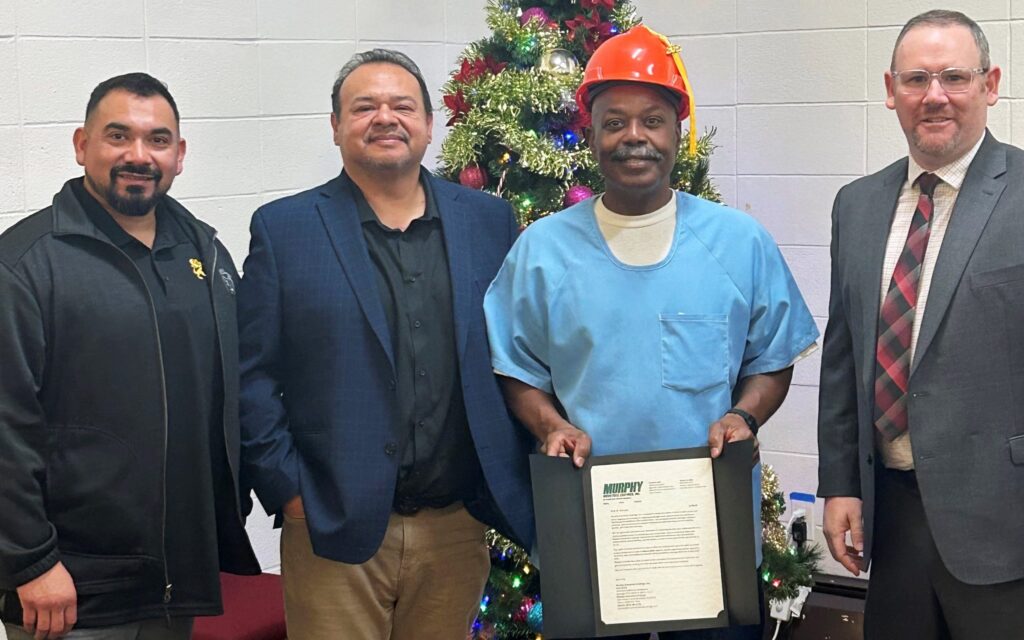
Last year in December, Murphy Industrial Coatings, Inc. presented Schrubb with a Letter of Intent to hire him upon release from prison. “Our company believes strongly in second chances,” the letter reads. “We recognize and commend your dedication to rehabilitation and your continued efforts to build a positive future for yourself and your loved ones.”
Schrubb said he plans to become a union member.
In January, Schrubb was one of 27 Facility Planning, Construction, and Management graduates recognized in the Correctional Construction Mentorship program.
Schrubb said the warden offered him a job that he has considered. “The warden’s offer specifically was a position as a maintenance man.”
Triumph, trauma and tragedy have challenged Schrubb’s resolve to become a better man. They collided in prison, but they also became an impetus for him to stay his course and change. He recalled a conversation with his then five-year-old grandson.
“I made a promise to my oldest grandson to be good and come home to him soon,” Schrubb wrote. “He, in turn, promised to do good in school. That motivated me to put my nose to the grindstone and make a drastic change.” He said his grandson went on to earn a full-ride football scholarship, but concussions stopped him from making it to the NFL. Violence took care of the rest.
“Sadly, in 2021 he was gunned down in Fresno by a gang member,” said Schrubb. He said one reason he keeps going is to fulfill his promise to his grandson who was killed at age 23.
“My mantra from the beginning was ‘I’m not going to die in prison,’ and I was going to walk out on my own power and be cognizant and healthy enough to live a decent life,” Schrubb wrote.
While pursing a parole date, Schrubb continues to move about San Quentin to work on himself, despite having completed self-help programs, multiple trades, receiving job offers, recommendation for recall of his sentence, and commutation of his sentence.
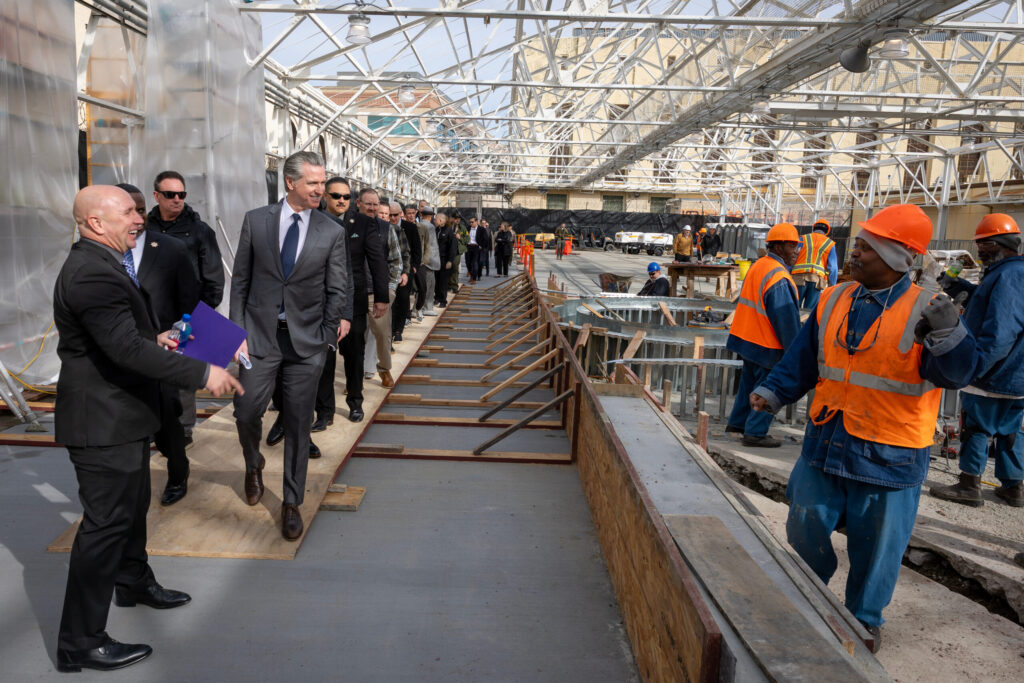
On February 20, 2026, while Schrubb was at work, he met Gov. Newsom. “When a tour came on the Upper Yard to the construction site, the warden pointed me out to the governor and called me over to the group,” said Schrubb. “It was one of the most exciting moments in my life.”
Schrubb said the warden introduced him as one of the people the governor commuted, and informed the governor that Schrubb has a job waiting for him when he is released.
Newsom and Schrubb shook hands, and the governor pulled him in for a shoulder bump and asked, “What are you going to do, man?” Schrubb responded, “I’m coming back to work for the warden.”
“‘Who gave you the commutation?’” Schrubb said Newsom asked.
“You did, man,” said Schrubb. He was all smiles as he told the story of how he came to meet the governor who believed in his positive transformation. “Mainly, the culmination of my rehabilitation journey started happening here. This is where it’s peaking.”