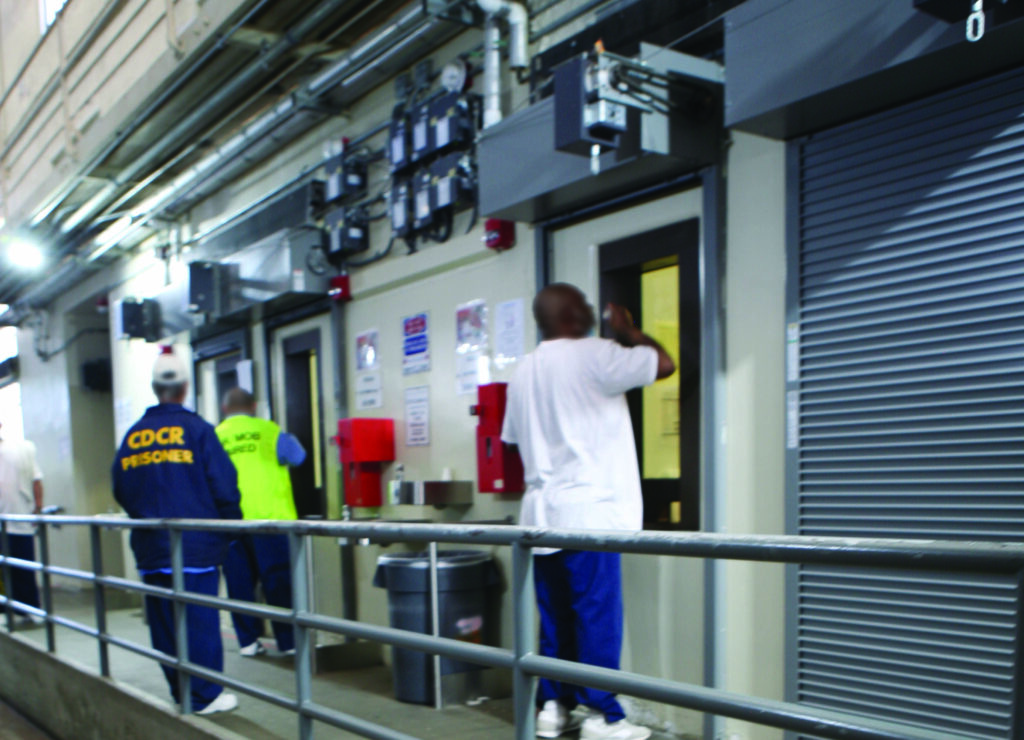
As California’s state prison system grapples with inmate overdoses from fentanyl, California Health Care Facility, in Stockton, California, the state prison system’s prized medical facility, has overprescribed at least one inmate-patient’s medication and compromised the health and safety of untold others.
Howard Forbes suffered from multiple sclerosis. The 53-year-old African-American is confined to a wheelchair and has been incarcerated 15 years. He said that for three years, CHCF had been giving him “double doses” of his medication to treat his MS.
“The institution has been wasting money on expensive drugs I haven’t needed for three years,” Forbes said, adding that he is in constant pain from the reverse effect of CHCF having discontinued the overtreatment. “The reduction in medication is apparent in my body.”
MS is demyelination, which means the body’s immune system eats away the coating of nerves, affecting movement and other body functions.
“I’m an officially named plaintiff in the Plata [v. Newsom] case,” said Forbes. From his wheelchair, he produced pages of documents of research meticulously done on his medical records by the Prison Law Office, the non-profit legal organization that represented thousands of prisoners in the class-action Plata case. Plata tackled medical neglect and overcrowding in the California Department of Corrections and Rehabilitation.
Forbes said his physician’s signature was used by someone else at CHCF, a claim supported by the doctor himself in a story published by The Sacramento Bee. Days after it was published in June, Forbes called attention to the article.
“Somebody authorized for this to occur,” Dr. Aliasghar Mohyuddin told The Bee about another incident with an inmate-patient, unrelated to Forbes. “And they should be brought to account for that.”
“Mohyuddin said he was meeting with an inmate at a Stockton prison a few years ago, when he pulled up the patient’s medical record,” The Bee reported. “In it, he found a letter documenting past care that bore Mohyuddin’s electronic signature. But the date on the record startled him: the doctor said he was out of the country at the time.”
Subsequent to that incident, Mohyuddin said he observed other files of inmate-patients he examined at CHCF. “Again and again he came across similar letters that said they were created and verified by the doctor,” The Bee reported.
“Mohyuddin estimates his e-signature has been used in a similar way at least 800 times,” The Bee reported. “He also alleges that orders for patient diagnostic tests and medications were placed under his name without him knowing.”
Mohyuddin questioned how something can be done without a doctor’s knowledge. He asked “What else was created or removed?” He has notified the Office of the Inspector General, the CDCR’s undersecretary, and Clark Kelso, monitor of the state prison’s medical system.
None of that provided relief to Forbes. On June 25, he said, “I can feel the progress of the disease inside.” Four days later, on June 29, he said, “I’m really feeling [pain] today.”