By Charles Crowe, Staff Writer
Persons experiencing homelessness face daunting challenges and inequities in their daily lives. Shunned and ignored, they are prodded to move along to what the author calls “the space that remains.”
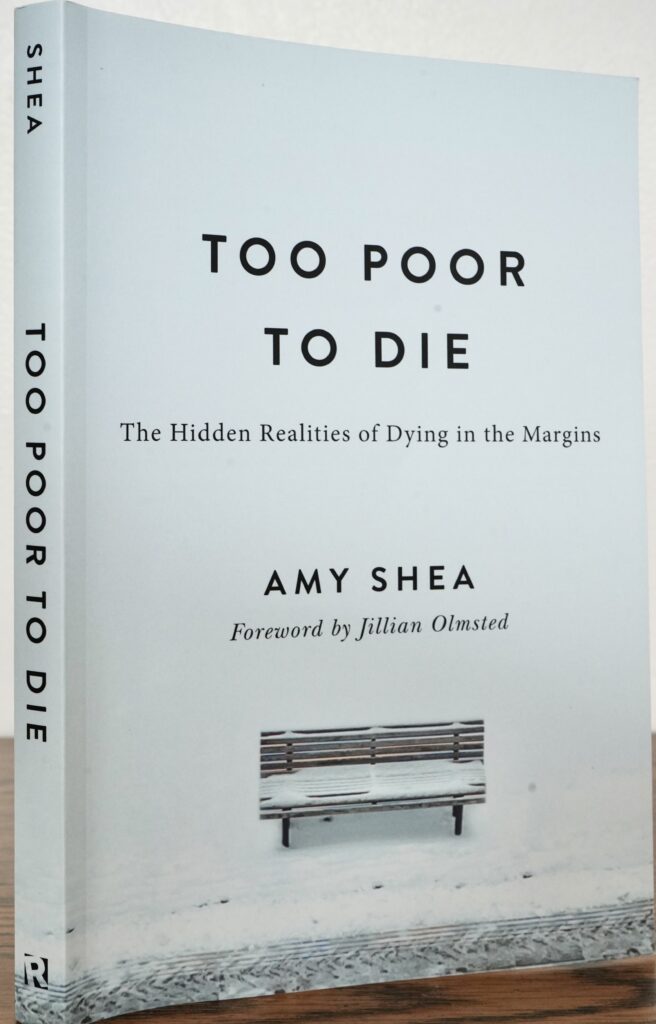
In “Too Poor to Die, The Hidden Realities of Dying in the Margins,” author Amy Shea lays bare the cold truth that those inequities often dog the homeless through the time of their dying and even into the grave.
Shea presents her exposé in a series of nonfiction, personal essays that blend seamlessly into a compelling narrative. One such essay, “Remembering the Forgotten, The Space That Remains,” takes place in a modern-day potter’s field in the author’s hometown of Fresno, California. After a brief ceremony in 2018, the county buried 740 unclaimed dead en masse. Such burials are periodic; these bodies had accumulated for nine years. Each of the 740 six-by-nine inch boxes held one set of cremains, all buried together in two wooden coffins in graves identified only as lot numbers 58 and 59, no names.
“Death is supposed to be the great equalizer,” wrote Shea. “The thing we all experience regardless of our class, race, or any other identities we’ve held or experiences we’ve had in life. Yet not all deaths are created equal. Not everyone has a good or dignified death or is treated with respect and dignity once dead.”
Although intensely researched — Shea’s bibliography spans 29 pages — “Too Poor to Die” is not detached, academic writing. The author doggedly pursued her topic in person, on the street and on the road.
Her quest for understanding spanned more than a decade and carried her from Fresno to such disparate locations as Phoenix, Boston, Salt Lake City, Lexington, and England.
She frequented coroner’s offices, morgues, hospices, medical facilities, and homeless shelters. She delved into documentary films like “A Certain Kind of Death,” with its graphic scenes of lonely deaths discovered only when neighbors smelled bodies decomposing. As described in her essay, “Field Notes of a Tombstone Tourist,” Shea haunted graveyards and cemeteries to contemplate the humble spaces that hold the remains of those who die on the margin.
The writer sought to learn from those whose daily business is caring for the poor, the homeless, the sick and the dying, as well as those tasked with disposing of dead bodies or cleaning up scenes of death. She sought the insights of cemetery groundskeepers, street doctors, nurses, social workers, and staff at end-of-life facilities and homeless shelters. Often, the writer saw in these places the heroic efforts of some who care for the homeless and those approaching death. In some cases she worked side by side with them.
Shea worked in the foot-care clinic of St. Francis House, part of the Boston Health Care for the Homeless program, as “foot-care assistant.” Her duties included “setting up basins for foot soaks and working with nurses to assess the condition of patients’ feet, distributing socks and towels … application of creams and powders, engaging [patients] in conversation (to establish rapport, which can result in the identification of further medical issues) …” In this role she confirmed the importance of foot health to one who must walk everywhere, and keep walking, because home is a sidewalk where loitering is prohibited.
In Salt Lake City, Shea learned from staff and residents of the INN Between, a facility she described as “… medical respite and end-of-life care for people experiencing homelessness.” There she sat and conversed with residents living out their final days in hospice.
As her work progressed, the author saw how lack of shelter affects health and healthcare. In clinics and at homeless shelters she witnessed the intense wear on bodies from constant exposure to the elements (burns from laying on hot concrete or pavement, frostbite from the cold, among other things). She saw that without a secure place, life-sustaining medications cannot be properly stored or refrigerated, and can be lost to theft or sudden encampment sweeps. For these reasons among others, Shea argued in her book that “housing is healthcare” (her emphasis).
“Too Poor to Die” is unapologetic activism, a call for compassion for those who die on our margins. Shea wrote, “Regardless of where we come from … we should agree that dignity in death is something that should be afforded to everyone, not just those that can afford it.”
In prose at once stark and compassionate, the writer has tapped into an almost universal value, that the dying and the dead deserve dignity and respect. As a reader, one is compelled to consider if those experiencing homelessness deserve respect any sooner. Students of Mount Tamalpais College may recognize Shea as the director of the College’s writing program. Students may borrow the book from the Mt. Tam library.