By Jerry Maleek Gearin, Journalism Guild Chair
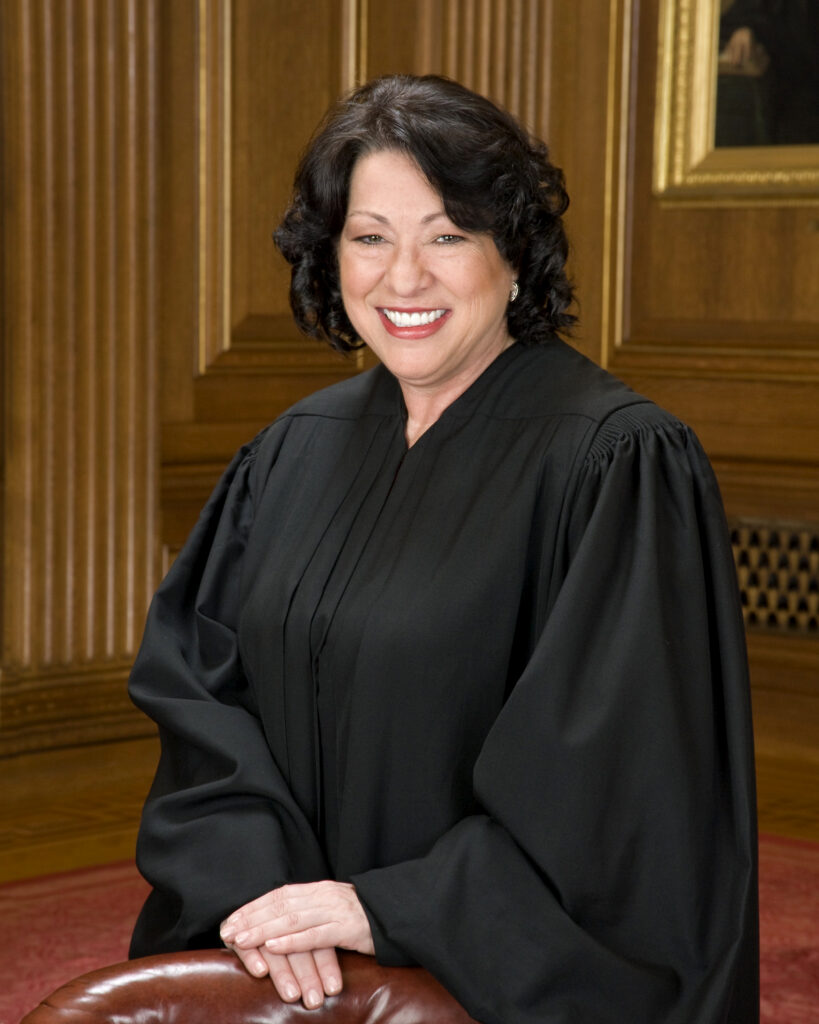
Jenny from the Block made hits, but Sonia from the Bronx made history as the first Latina to sit on the United States Supreme Court.
Sonia Sotomayor was born on June 25, 1954 in the Bronx borough of New York City to her native Puerto Rican parents, Juan and Celina Sotomayor.
S. Sotomayor was raised in a Puerto Rican community in the Bronxdale projects. Her mother purchased a set of Encyclopedia Britannica to emphasize Sonia’s education, a purchase uncommon in those projects, according to Wikipedia.
“I was going to college and I was going to become an attorney, and I knew that when I was ten. Ten. That’s no jest,” Sotomayor said.
In 1970, due to the increasing drug use and gang activity in the Bronxdale projects, the Sotomayor family found a safe haven in the Northeast Bronx.
As a result, Sotomayor attended Cardinal Spellman High School, where she joined the school’s forensic team and was elected to the student council, graduating as class valedictorian in 1972, according to Wikipedia.
Sotomayor cited affirmative action and her academic achievements as the reasons why she was accepted to Princeton University. She said her experience at Princeton was life changing, saying that she felt like “a visitor landing in an alien country” because there were very few Latinos at the school.
Sotomayor felt too anxious to inquire and ask questions in class; she said her literacy and vocabulary skills were not the same as non-Latino students. However, she spent long hours studying in the library, working hard in the summers with a professor to improve her skills, knowledge, and confidence, noted Wikipedia.
She was a student activist, advocating for Latin American history classes and hiring Latino professors. She co-chaired the Acción Puertorriqueña organization, a social and political hub that advocated for increasing opportunities for Puerto Rican students, noted Wikipedia.
Sotomayor graduated from Princeton in 1976 with highest honors and received her Juris Doctorate in 1979 from Yale Law School, where she became an editor for the Yale Law Journal.
She was admitted to the New York State Bar in 1980 and worked as an Assistant District Attorney in New York for more than four years, noted Wikipedia.
After working for seven years in private practice, Sotomayor was confirmed in 1992 to the U.S. District Court for the Southern District of New York. In 1998 she was confirmed to the U.S. Court of Appeals for the Second Circuit.
Her appointment to the Court of Appeals was delayed because U.S. Senate Republicans feared it would lead to a Supreme Court nomination, stated Wikipedia.
Some opponents found Sotomayor to be confrontational, saying she used her line of questioning to make a point rather than to seek an answer to a question.
“Some lawyers just don’t like to be questioned by a woman,” said Second Circuit Judge Guido Calabresi. “[The criticism] was sexist, plain, and simple.”
On May 26, 2009 President Barack Husein Obama nominated Sotomayor to the U.S. Supreme Court. In a Senate confirmation hearing she was criticized by Republicans for a line she used in a 2001 Berkeley Law lecture: “I would hope that a wise Latina woman with the richness of her experiences would more often than not reach a better conclusion than a white male who hasn’t lived that life.”
Obama’s nomination mirrored his campaign promise that nominated judges would have “the empathy to understand what it’s like to be poor, African-American, and disabled,” according to Wikipedia.
She was confirmed to the Supreme Court in a 68-31 vote by the U.S. Senate in August 2009. As a Supreme Court Justice, Sotomayor identified with the rights of criminal defendants, which was demonstrated in her written opinions, noted Wikipedia.
In her first Supreme Court dissent Justice Sotomayor wrote a stay of execution for Jason Getsy, a convicted murder-for-hire defendant, according to the Los Angeles Times.
In a 1995 Ohio murder-for-hire plot, Getsy shot Charles Serafino seven times. He survived, but his mother, Ann Serafino, was shot and killed.
Getsy’s lawyers claimed he should be spared the death penalty, stating that other participants, including John Santine, the main conspirator, did not receive the death penalty, stated the L.A. Times.
The Court’s majority opinion denied Getsy’s appeal in a 5-4 vote. Getsy, 33, was put to death by lethal injection.
Sotomayor’s opinion was supported by fellow Justices John Paul Stevens, Ruth Bader Ginsburg, and Stephen G. Breyer, noted the L.A. Times.
In 2010, Sotomayor received a cash advance of $1.2 million to write her memoir, Mi mundo adorado (My Beloved World); three years later her book was published in Spanish and English, according to Wikipedia.
In a New York Times book review, Michiko Kakutani wrote “…[Mi mundo adorado is] an eloquent and affecting testament to the triumph of brains and hard work over circumstance, of a childhood dream realized through extraordinary will and dedication.”