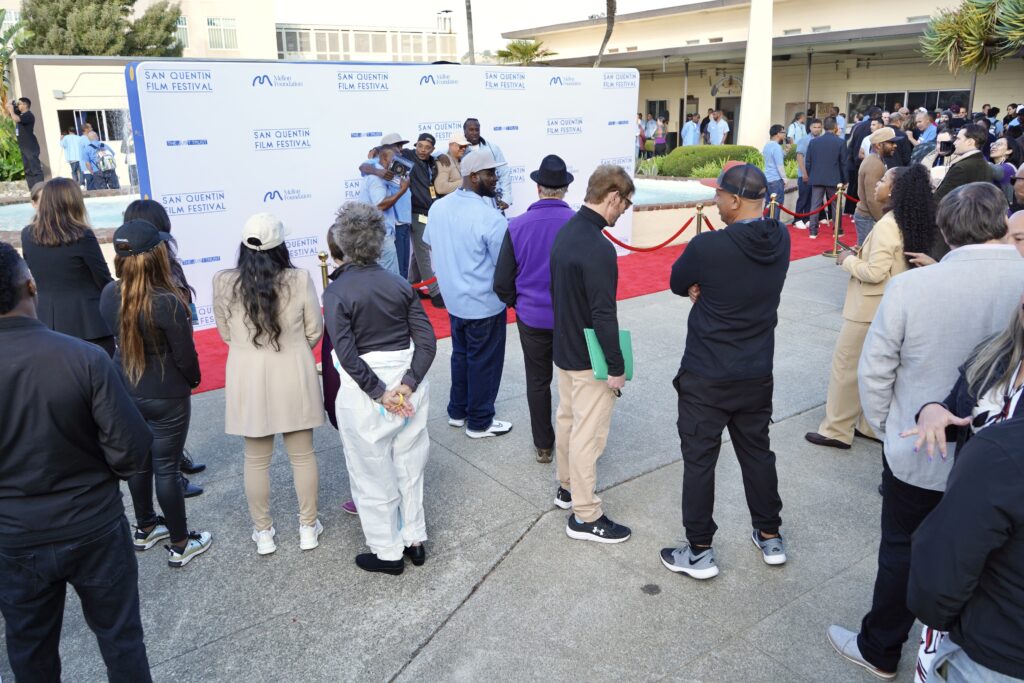
San Quentin’s version of a red-carpet event, the 2025 San Quentin Film Festival, celebrated and highlighted the transformative power of film and filmmakers.
Organizers dedicated the event to the memory of Marcus “Wali” Henderson, former editor-in-chief of San Quentin News and a member of the incarcerated team that put on last year’s film festival.
Rahsaan Thomas, co-director of and consultant to the film festival, said he first met Henderson at Calipatria State Prison. When Henderson arrived at San Quentin, Thomas, who was sports editor at San Quentin News, recruited him to write sports articles.
“When we met again at San Quentin, I needed help in the sports department. He didn’t care about his appearance, he cared about impact and about people,” Thomas said.
Henderson’s release from prison came finally in 2024. Shortly thereafter, surrounded by his family and friends, Wali lost his battle with cancer.
Thanks for the success of this year’s film festival goes to a progressive warden, cooperation from facility staff, and the many generous donors who support the work and creativity of San Quentin residents.
The festival allowed film industry professionals to glimpse the prison experience by witnessing work created behind the walls by incarcerated people, something not generally highlighted in outside media.
Putting on an event of this size involved many moving parts facilitated by prison administration, volunteers, donors, and incarcerated people. Incarcerated residents assigned to the California PIA paint vocation refurbished hundreds of chairs for the event space.
“We worked on about 200 chairs. We removed all the staples, cleaned the chairs, and restored them by adding wood to the underside so when someone sat down, they didn’t sink into the chair,” said resident Demarion English.
Incarcerated facilitators of the American Sign Language class helped deaf community members enjoy the two-day event by translating parts of the festival that were not close-captioned on the big screen.
Incarcerated filmmakers, producers, and sound engineers operated cameras, lighting, and sound equipment to ensure a successful event.
The event would not have been as welcoming without The Greater Good, an incarcerated 10-member ensemble. The band performed more than 50 musical selections, ranging from a Romany-Gypsy tune from Bulgaria to the famous “Working Man Blues” by Merle Haggard, a San Quentin resident in the 1960s. The selections rang throughout the chapel’s outdoor courtyard.
On the outside, artists can create scripts, direct films, and produce documentaries using cell phones, user-friendly software, and artificial intelligence.
For incarcerated filmmakers, making films is not that easy. Their challenges include limited access to equipment, movement restrictions, and before an idea can become something shown to an outside audience, the administration must approve the content.
“When you’re talking to somebody and they’re in the moment telling you an impactful story, you can’t tell ’em to hold those emotions and come back next Thursday,” resident audio-visual worker Jeremy Strain said. “That’s a moment you will never get back. It will never be the same.”
Strain said that filming outside the media center has been challenging due to pushback from correctional staff, mostly because they are unaware of the filmmakers’ work.
“We try to be transparent … by speaking to the supervisor and the custody staff on location to limit the chance of conflict,” Strain said.
Incarcerated filmmakers are motivated to carry their message of rehabilitation, redemption, and freedom to incarcerated people and to people on the outside. However, they do not often see how outside people perceive the work.
“Working in audio and video … I get to see all the inside activity, the production, the creativity, and even the finished product,” Strain said. “We don’t get to see all the reactions from outside. We can ask our families, but it’s not the same.” The film festival provided Strain a chance to witness those reactions firsthand.
Two-hundred fifty people applauded, cheered, and gave standing ovations to the incarcerated storytellers highlighted at the festival. Residents and visiting guests alike look forward to next year’s celebration of San Quentin’s filmmakers.
“It is worth the celebration for the incarcerated because we don’t get to interact with free people at other institutions. That’s what makes San Quentin unique,” said resident Donell Haynie.