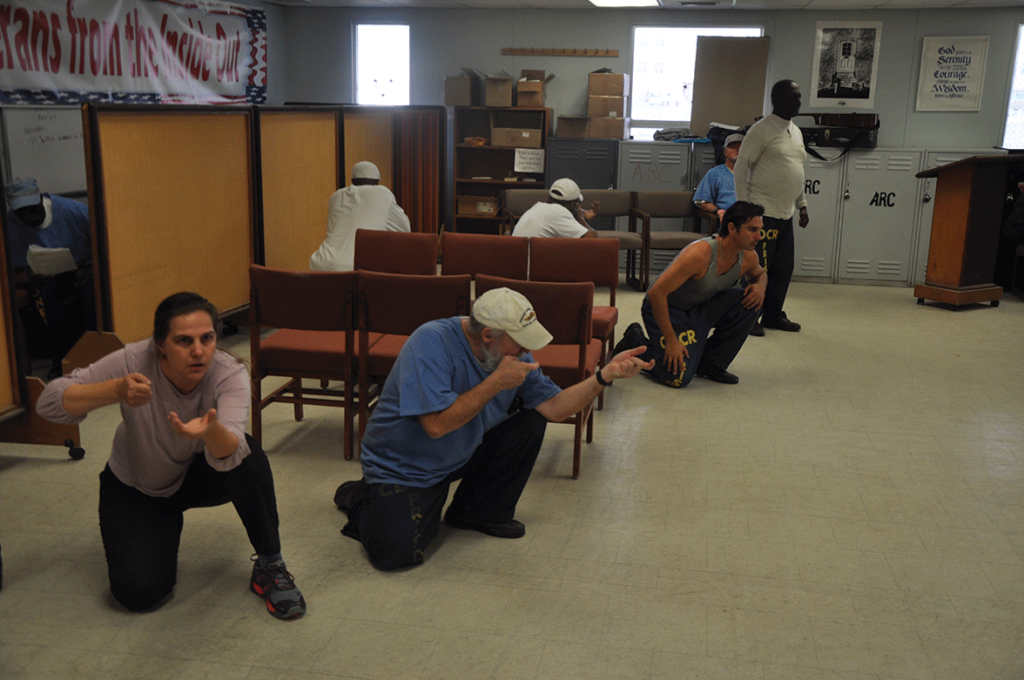
An individual who joins the military and serves their country through unfamiliar terrain show bravery while enduring life altering circumstances. Incarcerated veterans at San Quentin shared that same bravery in a Shakespeare style theatrical production highlighting social issues veterans face after discharge.
The performers are part of the Veterans Healing Veterans group at San Quentin, founded by former resident Ron Self, which is based on trauma-recovery training veterans on ways to cultivate insight and selfregulation. The program collaborates with programs and agencies to provide mindfulness, yoga, theatre, and assists incarcerated veterans seeking benefts. VHV has been an important platform for residents at San Quentin since 2014.
The scene: service members outftted in fatigues and trudging through mud underfoot in pairs, bent double like old beggars under sacks, they marched on bloodied, blind, and deaf even to the hoots of gas-shells dropping softly behind them.
The performance, “The Thanks We Carry,” was a nod to Tim O’Brien’s “The Things We Carry,” memoirs of the Vietnam War; and poems like Wilfred Owen’s “Dulce et Decorum” and Robert Laurence Binyon’s “The Healers,” highlighting events of World War I.
In Chapel B, the presentation raised awareness to the harsh reality of hearing the words “Thank you for your service,” and the struggles veterans face after they served their country. Those words meant more to those present than what they appeared.
Resident Ray Melberg served in the U.S. Air Force. He said that hearing “Thank you for your service” means different things to different people.
“[Some people] say it because they don’t know what else to say, but sometimes I can see people really mean it and have been waiting for the opportunity,” said Melberg. “I accept that they mean it from whatever place their able to say it from.”
During the performance, veterans who fought in various wars shared some of the supportive catch phrases created during wartime in order to show the American people supported the troops who sacrifced their lives.
“[Today] it’s ‘Thank you for your service.’ During the Gulf War it was ‘Support the troops, not war,’ and people tied yellow ribbons everywhere when we returned home,” said U.S. Navy veteran and resident Steven Joyner.
“When I was 18-years-old, a 20-year career in the U.S. Navy seemed too long, and like I was giving the Navy too much,” Joyner said. “But when I was 45-years-old, 23 years of service seemed too short, and I felt the Navy still had a lot to give me.”
Another veteran shared his experience serving in the Vietnam War, stopping midsentence. The room stood quiet as the performer took a deep breath. In unison, they all gave an audible exhale as the entire room fell silent.
“People did not want to talk about it then, either,” Joyner told the audience.
Steve Drown said he appreciates the compassion veterans receive today, but he hopes its not a form of trying to overcompensate for the treatment they received after the Vietnam War.
“I can’t help but think that if I’d gotten the care then, I wouldn’t be here now,” Drown said.
As the performance continued, veterans shared some of their proudest moments of answering the call for service.
Resident Greg Ward said he is proud of answering the call to be of service. As a frst responder, he said he had the opportunity to be helpful to someone in need.
Melberg said he is proud to witness the acknowledgement veterans receive within the San Quentin community.
“I’m proud that former service members are recognized as leaders in the new rehab center environment,” said Melberg who made note of the chronic issue of homelessness among veterans. He expressed that he wants to continue being of service to other veterans.
“I can’t tell when I see a homeless person if they are a veteran or not. I might be passing a veteran who is suffering from his or her service. So is there a way to solve this dilemma? I challenge myself to regard every person living on the street with the esteemed regard I have for a veteran,” Melberg said.
Resident Andrew Gazzeny said his proudest moment was geographical more than anything was.
“I’m proud that I was born in America. I could’ve been born just about anywhere,” Gazzeny said.
Some veterans expressed that their proudest moments were what their family members received because of their service. Manuel Medina said his wife was able to obtain her bachelor’s degree and that was a proud moment for him.
Veterans of San Quentin aimed to address social issues that affect all service members’, wheather active or discharged. The Veterans Acting Program is a space where residents discussed traumas of service and set out to share with the community though a Shakespearestyle performance titled “The Thanks We Carry” which gives credit to the personal experiences of the incarcerated performers.
At the closing of the performance, the performers shared their experiences of incarceration and the encounters they face as veterans returning to society, and some of the fears that loom in the distant future.
If you’re a veteran or know a veteran who is homeless or at risk of homelessness, please call the National Call Center for Homeless Veterans at 877-424-3838 for assistance. The staff is available 24/7. They can connect you with your nearest Veterans’ Administration for help.