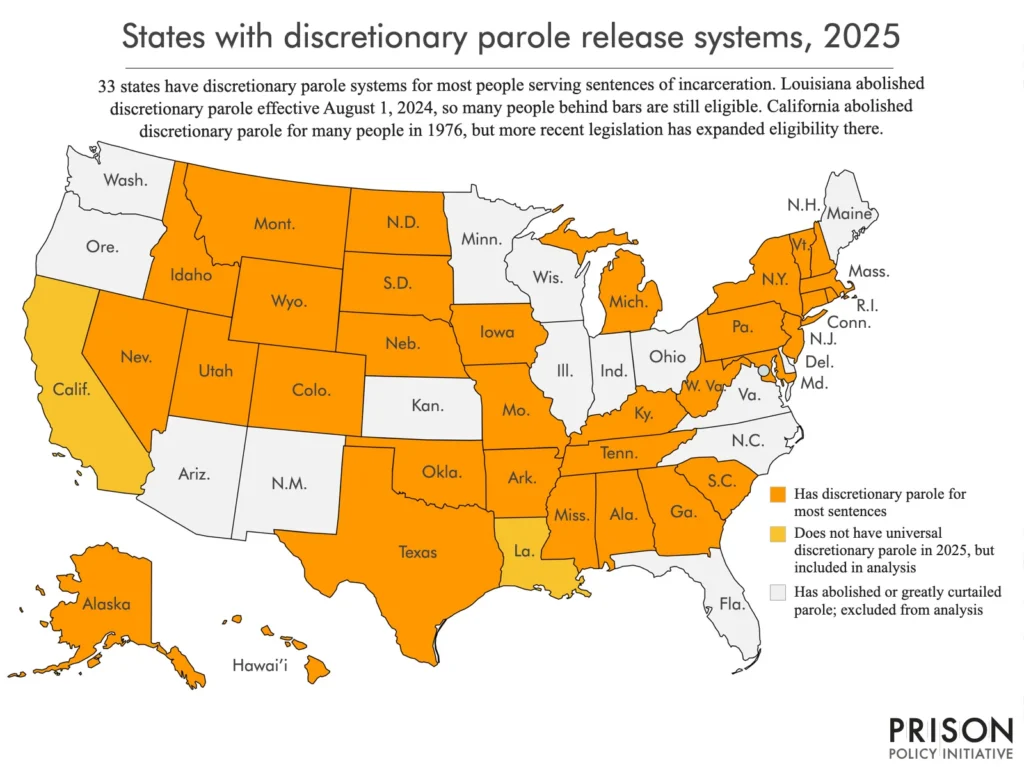
“No state is ‘doing’ parole well,” concluded a Prison Policy Initiative study of the discretionary parole system in California and 34 other states.
The October 2025 report “Parole in Perspective: How parole boards and hearings work,” explored the mechanics of discretionary parole systems and recommended ways to make them more effective as tools for decarceration.
The systems studied often fail to ensure parole hopefuls adequate and impartial hearings, wrote report author Leah Wang. “Despite these shortcomings, discretionary parole remains a vital tool for decarceration, and having parole systems we can improve is better than not having them at all.”
PPI studied who serves on parole boards. Required qualifications vary greatly among states, but generally do not include diverse perspectives or experiential knowledge of incarceration. The most common qualification is law enforcement background, resulting in dominance of pro-punishment voices on boards. California requires that the board “reflect a broad ‘cross-section’ of the state’s population,” said the report.
Governors appoint most parole commissioners and thereby “utilize this power to imbed their values into the criminal legal system,” wrote Wang. Four states limit commissioners’ terms, but most allow indefinite service. California commissioners serve three-year terms, but the governor can reappoint them without limit.
Some states call for boards to include professions like social work, psychology, or sociology, which may favor decarceration or have understanding and empathy for parole applicants. However, Wang noted that often these requirements are “conflated” with law enforcement experience.
Arkansas for example, calls for experience that includes “… parole or post-release supervision, probation, corrections, criminal justice, law, law enforcement, psychology, psychiatry, sociology, social work, or other related fields.” Such open-ended guidelines allow emphasis on pro-punishment voices while ignoring others.
Alternatively, PPI recommended that “qualified community-based practitioners from psychology, trauma-informed care, and substance use or mental health care” be explicitly required on parole boards.
No state requires its parole board to include a formerly incarcerated person, or one with lived experience within the criminal legal system. Without such representation, Wang said that boards “may never truly reflect traditionally policed and incarcerated populations.”
Parole board size varies greatly, from three members in Alabama to 21 in California. Vacancies and heavy workloads can result in backlogs and rushed decisions. Commissioners’ time is “in high demand,” with the result that “all states with discretionary parole have a sizable share of the prison population that is behind bars past their parole eligibility date,” said the report. As of PPI’s report, California’s 21-member board was full.
Smaller panels, rather than full boards, commonly conduct hearings, allowing boards to split up workload in order to conduct hundreds of enquiries each month. Two commissioners sit for each hearing in California.
PPI recommended larger boards in some states, noting that the Council of State Governments estimates more than 200,000 persons are waiting for overdue hearings. “There are simply not enough parole board members to conduct hearings and make decisions in both a fair and timely way,” wrote Wang.
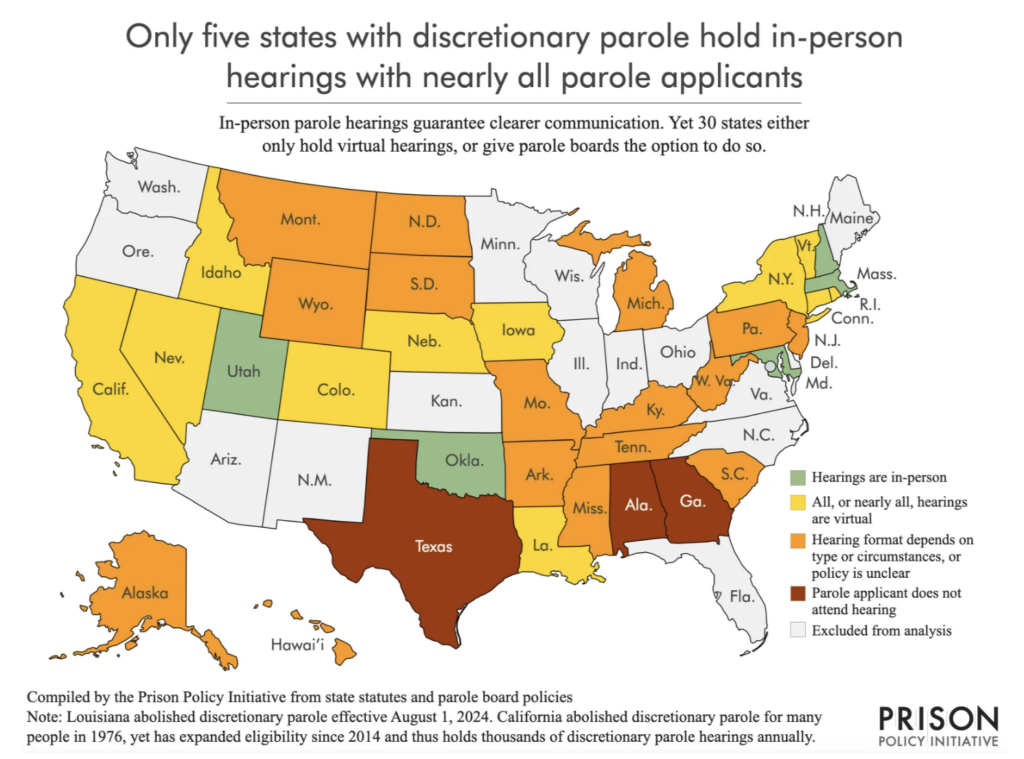
Hearing format varies widely by state. Some have face-to-face hearings while California and others hold most hearings virtually, a growing trend since the onset of the COVID-19 pandemic.
PPI lamented the trend to virtual hearings, calling them “objectively different” from in-person meetings, and argued “… applicants deserve to sit before the people who will grant or deny their freedom.” Face-to-face hearings are better for conveying emotions and building trust through eye contact and body language, wrote Wang.
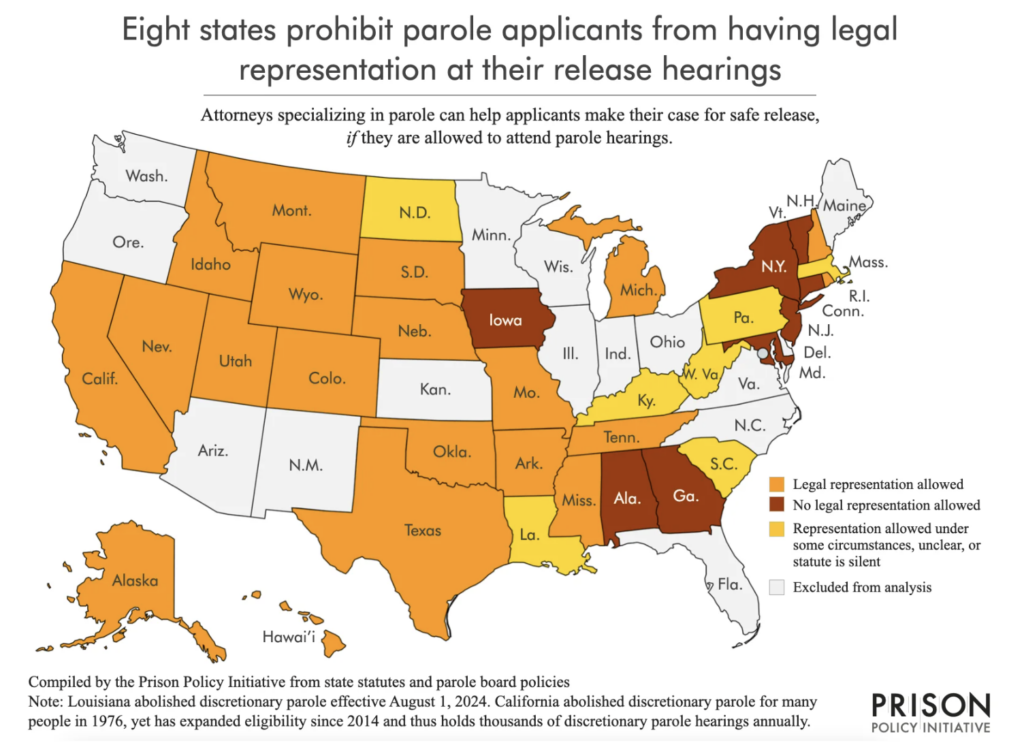
Only 24 of the 35 states PPI surveyed allow parole applicants attorney or other representation at parole hearings. California provides state-funded attorneys to those who cannot afford private representation. The report writers recommend that all parole hopefuls have access to “free and competent counsel.”
More than half of states hold public hearings, establishing a record to hold boards accountable. Opponents, and in some cases advocates, of a parole candidates’ release have opportunity to address the board.
Opposition to parole often receives favored treatment, as in California, where district attorneys, victims, and victim advocates have a voice at parole hearings, but advocacy for the parole applicant is limited to attorney representation. PPI recommended public access to hearings, whether virtual or face-to-face, and free access to related transcripts.
The report’s overall assessment of discretionary parole is poor. “As it stands, parole systems have largely kept prisons overcrowded … they are politically-motivated, under-resourced, and largely dysfunctional as a mechanism for release.”
By recommending larger, more diverse boards and increased transparency in the hearing process, PPI seeks to enhance the “enormous potential of parole boards as a tool for decarceration.”