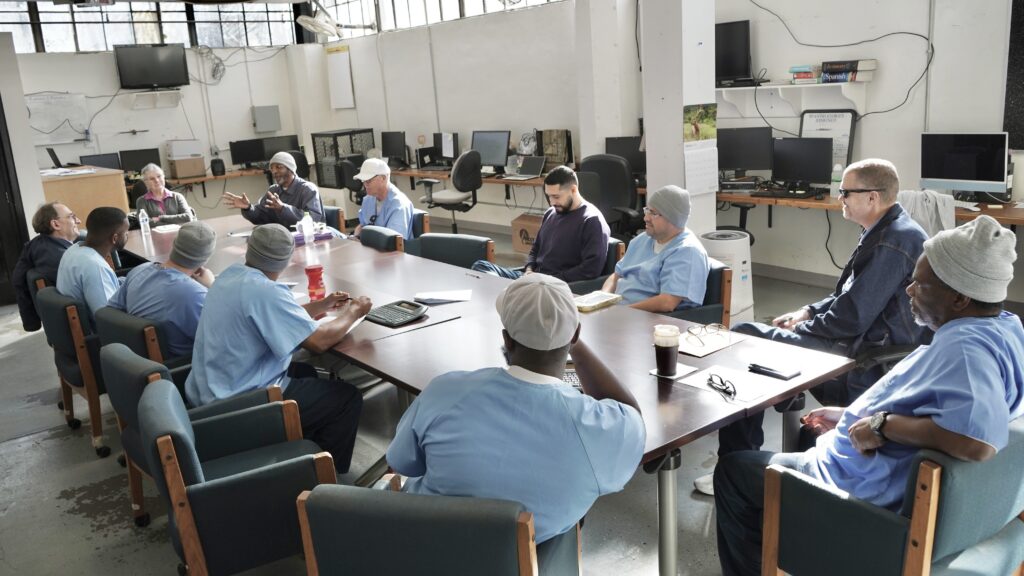
In the fancy new digs of the San Quentin News everything is fresh, including an oval table about eight feet long that seats six. Two electrical outlets in the center lead to a power source in the floor below, a techy feature emblematic of the newspaper’s new space.
What the up-to-date table lacks is history. Memories will have to be made there. Meanwhile, it has big shoes to fill. Its predecessor, rich with history, was abandoned in the move from the old newsroom.
That massive piece of furniture was the dominant feature in the old newsroom, and had for years been the proverbial fly-on-the-wall in the space. It witnessed much and served the newspaper in many ways. The stories it could tell to the new table.
The big surface was 20 feet long by four feet wide, a great rectangle that actually consisted of eight smaller tables locked together. Its size made it a magnet because very large, flat surfaces are scarce in prison and useful in many ways.
Wood-framed, padded chairs (padding not being a common characteristic of chairs in prison environments) surrounded the big fixture, anywhere from 16 to 20 depending on the number of people gathered around the table at any time.
The table could host gatherings large enough to promote a sense of belonging and community among the newspaper’s staff. Every Wednesday morning, the whole staff and their outside advisers attended a mandatory meeting around the giant desk. A succession of Editors-in-Chief led the group through an agenda and heard reports from department heads and advisers, all followed by an “open forum,” where any topic was fair game.
Juan Haines, who spent years with the newspaper in various roles, recalled a definitive moment at one such meeting around the big desk. Then Public Information Officer Lt. Robinson sat in with the newspaper’s outside advisers.
The paper’s incarcerated staff disagreed with the outside advisers over a key strategic question. The advisers wanted to go in one direction, the staff preferred another path, and the issue reached an impasse.
As Haines recalled, he turned to Lt. Robinson and said, “Lieutenant, whose paper is this?” Robinson replied, “It’s your paper.” The incarcerated staff had their way and Haines received the confirmation he sought that the newspaper was, in fact, still run by incarcerated men.
The big table also served as a public square for decision-making. At monthly layout meetings, generations of managing editors led spirited discussions that determined which stories made the front page. Writers made passionate pitches for their stories and staff voted yea or nay by a show of hands.
The sturdy furniture stood up under the weight of many grievances and disputes thrashed out at “grown-man meetings,” a quirky San Quentin News tradition that often featured clashes between strong personalities. Profanity sometimes flavored the harsh words that flew back and forth at these encounters.
On occasion, Super Bowl Sundays for example, workers from the entire media center gathered around the big table to break bread and foster unity between departments. Those who volunteered to prepare food spread large garbage bags on the big space to make a sanitary prep surface. Nachos and burritos typified the fare at these events and the prep work could get messy.
The long table served as a loading dock for incoming shipments of newspapers. After a forklift dropped a pallet of 5,000 newspapers at the front door, staff formed a bucket-brigade from the pallet, through the anteroom, and inside to the table. They passed the 100-paper bundles hand-to-hand until the last man stacked them on the table. With the copies inside, workers bagged them for distribution to housing units and other destinations.
Frequently, a sudden call from the PIO announced an incoming tour. A few minutes later, a big group would show up and take seats around the table. Visitors heard staff present the newspaper’s history and asked questions to satisfy their curiosity: What kind of stories do you write? Are you censored? How do you get a job at the newspaper? Do you have internet access? What are you in for?
Teachers, journalists, legislators, judges, district attorneys, governors, wardens, donors, cops, and mental health professionals composed many of the tour groups. Sometimes correctional staff from other prisons and foreign countries came. High school and college students, church groups, librarians, evangelists, and almost any other type of group one can think of visited. And once, Norwegian royalty.
Because writers outnumbered computer work stations, the big desk often served as a workspace for story creation. Writers scribbled notes, tapped on NEOs, and sometimes conducted interviews there.
Journalism Guilds gathered around the long table to study their craft each week. Numerous symposiums assembled there.
ISUDT has moved into the space that previously served as the newsroom. They dismantled and got rid of the big table. But it looms large in the memories of San Quentin News staff. In the midst of the otherwise dilapidated, grubby environs of the old newsroom, the table was a clean, shiny surface, in a word, unusual. And valued.