The failures of education continue to be a contributing factor to mass incarceration, with solutions still being sought.
“If we don’t focus on literacy and helping people learn how to read, then rehabilitation is a joke,” said Executive Director of the Fulcrum Literacy Program Dr. Kareem Weaver.
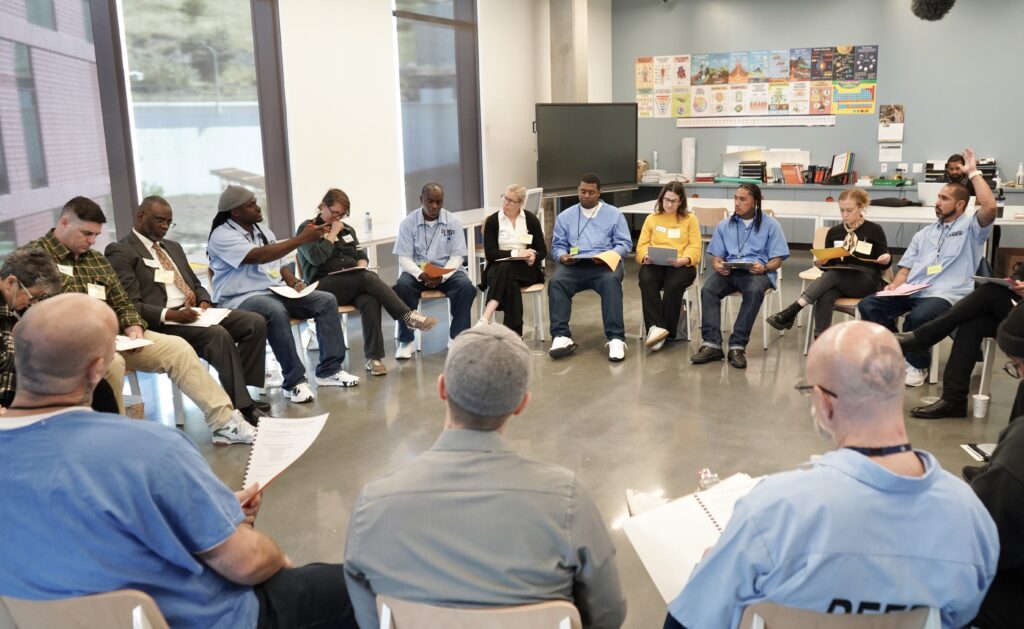
Dr. Weaver was a keynote speaker at a recent literacy symposium held at San Quentin Rehabilitation Center.
During his lecture, Dr. Weaver shared a 30-year-old study by the Department of Justice that noted, “Reading failure is most likely a cause, not just a correlate, for the frustration that can and does result in delinquent behavior…”
According to data from the LiteracyMidSouth website, 70% of adults incarcerated in the United States are unable to read above a fourth-grade level, while those incarcerated in the California Department of Corrections and Rehabilitation have, on average, an eighth-grade reading level, substantiating the Department of Justice research.
Poor literacy rates are a common result of a well-known education trend referred to as the “school-to-prison pipeline.”
In one of its studies posted online, the American Civil Liberties Union defined the school-to-prison pipeline as a trend in the U.S. that is characterized by “policies and practices that prioritize punishment over education” and “criminalizing minor behavioral infractions until students are funneled out of public schools and into the juvenile and criminal justice systems.”
After Paul Flores, a San Quentin resident, developed low self-esteem as a result of the negative treatment he received from his high school teachers, he said street gangs made him feel accepted and gave him a sense of self-worth.
“I didn’t feel accepted at school, so I ended up going out into the streets and getting involved with gangs,” said Flores at the literacy symposium.
A term first used in the early 2000s, the “school-to-prison pipeline” describes an educational environment comprised of harsh, “zero tolerance” rules that often lead to the suspension or expulsion of a student, along with the high rates of police presence on campus that help turn “discipline issues into criminal records,” according to the ACLU.
These policies help contribute to dropout rates amongst students who lose hope in education once they fall behind, often leading to criminal behavior and eventually arrest.
“If your goal is really about getting people to the top, then your system will reflect that,” said Dr. Weaver.
Dr. Weaver said the problem is the system is designed in a way that skips steps through the educational journey and doesn’t address every child.
“I suffered a lot of abuse by my mom and would go to school angry,” said Trevor Patton, a San Quentin resident. “I stopped listening to the teachers and just became disruptive.”
Patton said he was suspended 43 times in the sixth grade, and in the seventh grade it became difficult to get to school because he was suspended from the school bus for the entire year. He said he believes teachers need to understand what is going on with students outside of school because that plays a big part in what happens when they are in school.
The ACLU has reported the school-to-prison pipeline also disproportionately affects students of color, which can have negative results on graduation rates.
Data from the Census Bureau show 81% of Black students and 83% of Latino students in the U.S. graduate high school, compared to 90% of white students.
“I knew that I had been passed on from grade to grade, but I didn’t understand that graduating the way I did didn’t prepare me for the world,” said Curtys Taylor, a San Quentin resident and former literacy mentor at the facility. “The school system was supposed to empower me to believe that I could go out into the world and succeed, and they didn’t.”
Taylor said he believes that a major problem is that the teachers don’t understand the students because they don’t look like them.
Eighty percent of all public school teachers across America are white, even in communities where the majority of students are Black and Latino, according to the Pew Research Center.
Twenty-eight percent of all students in the country are Latino, and 15% are Black. By contrast, only 9% of educators are Latino, and 6% are Black.
“How can you teach someone you may fear or despise?” said Taylor.
At the symposium, incarcerated residents, outside guests and educators came together in several workshops to discuss possible solutions.
During one workshop on Teaching Strategies, Dr. Dela Morris, educator and Chairwoman of the Oakland chapter of the National Association for the Advancement of Colored People, said that she focuses on marrying curriculums with real-life examples so students can easily connect with the information.
“Its important to meet students where they are and understand where they come from,” said Dr. Morris.
The school-to-prison pipeline continues to be a complex problem creating huge impacts in communities. Improving the functionality of education systems may begin turning out more success stories and less future prison numbers.
“When we begin to talk about trauma, school trauma is the biggest issue. We have to undo the harm. Educators need to be prepared, skilled, and ready to deliver on the promise of education,” said Dr. Weaver.