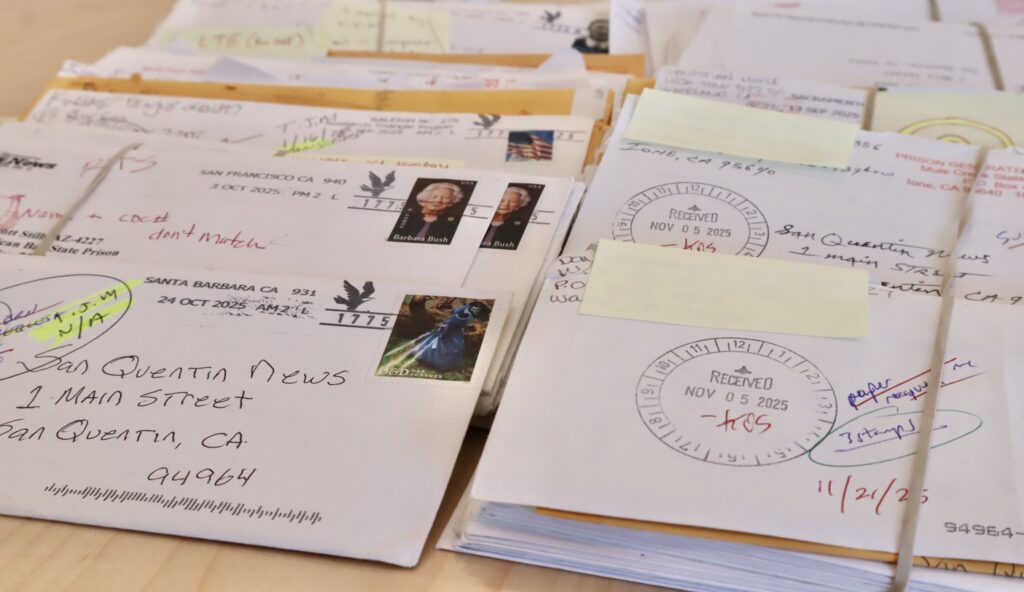
Technology is increasingly becoming the primary source of communication for the majority of people incarcerated in the United States who are banned from directly receiving physical mail.
Nearly 600,000 inmates in prisons across 34 states, 78% of America’s total prison population, are not allowed to receive physical mail, including letters and photographs, according to research from Prison Legal News.
Inmates facing restrictions are left with one of two options. Their incoming mail is digitally scanned and uploaded on tablets where they can read it, similar to a text message. The second option is to have the mail photocopied by prison staff or an outside company, and afterward inmates are given the copy and the original is usually destroyed.
The restrictions can be a detriment for many incarcerated people accustomed to receiving letters and pictures from loved ones.
“People depend on the physical mail,” said Deshawn Ford, a resident at San Quentin Rehabilitation Center. “There is a whole ritual to it, especially when you hear your name during mail call and you get the mail and just feel good receiving something from your family.”
Over the last seven years prisons across the country have been utilizing the services of third-party companies to scan and photocopy mail. The largest of these companies is Securus. Through its subsidiary company JPay, and with contracts in multiple states, Securus scans the mail for more than 21% of the nation’s prison population, according to Prison Legal News.
Resident Ford said when he was housed in Marin County Jail, all incoming mail would be rerouted to Las Vegas, Nevada for inspection. He said it wasn’t out of the ordinary for it to take months to receive the original copies of letters.
“It was discouraging for me and my family. They weren’t motivated to continue writing knowing that I wasn’t getting the mail,” said Ford.
Prisons and unions representing prison guards throughout the country say that mail restrictions, and accompanying alternative methods, are necessary to stop the flow of contraband and drugs into facilities. Although prison officials in dozens of states claim that an abundance of drugs enter institutions through general and legal mail, the Prison Policy Initiative reported, “There’s no solid evidence to date that mail scanning has the intended effect.”
Prison Legal News has documented incidents in multiple states where the implementation of mail scanning had little to no positive results. In Florida, only two percent of contraband originated in mail, and in Missouri there was an increase in monthly drug overdoses even after Securus began scanning mail for the state’s prisons.
In some states restrictions have even begun affecting legal and other privileged mail, long safeguarded by legal precedent.
In groundbreaking cases Davidson v. Scully, 694 F.2d 50 (2nd Cir. 1982); Wolfish v. Levi, 573 F.2d 118 (2nd Cir. 1978), and Reneer v. Sewell, 975 F.2d 258 (6th Cir. 1992), federal courts ruled that incoming privileged mail, including legal mail, can only be held long enough “to identify the prisoner addressee.” The rulings state that legal mail “may only be opened and screened for contraband” when done quickly and in the presence of the prisoners to whom the mail is addressed.
None of this seems to matter for states like New York, where prison guards have been photocopying legal mail since September of 2025. Other states, including Hawaii, have been using T-Ray scanners provided by RaySecur to take three-dimensional images of legal mail to inspect for contraband.
The restrictions, well intended as they may be, have placed many incarcerated people who would rather have mail the old fashioned way, at a disadvantage.
“I still get letters and pictures every other week, and I prefer them over the photos we can print on the tablet. The walls in my cell are full of family photos and affirmations,” said San Quentin resident Corey Holmes. Holmes said the personal nature of the letters is what he loves most, and would be the most difficult to go without.
“There’s something very personal about being able to get those letters and see that handwriting. It would be a catastrophe to lose,” said Holmes.