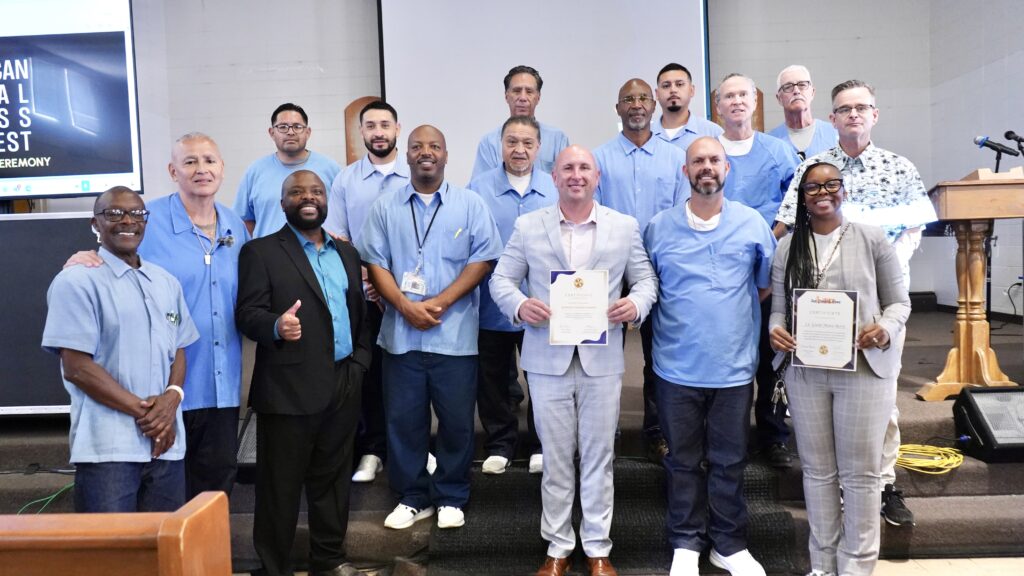
The Nash News, the CCWF Paper Trail, and The Echo (with its sister publication 1664) emerged triumphant in the American Penal Press Contest, whose award ceremony took place September 19 at San Quentin Rehabilitation Center’s Chapel B.
Of 36 awards in 14 categories, The Nash News won six. The CCWF Paper Trail and The Echo/1664 each won five. The Mule Creek Post won four. The North Carolina Prison News Today and The Angolite each won three, rounding out the top six winners. The Mabel Basset Balance, the Cajun Press, the Prison Mirror, and San Quentin News all won two awards of 12 recipients, but San Quentin’s newspaper won the highly coveted first place in the Best Newspaper category. It also won a second prize in the Best Local Coverage category.
“Progress comes from the mind,” philosophized Ron Broomfield, retired San Quentin warden, about prison journalism. Broomfield, an established supporter of prison journalism, later worked as Director of Adult Institutions of the California Department of Corrections and Rehabilitation until his retirement.
San Quentin News Editor-in-Chief Kevin D. Sawyer and Pollen Initiative Editorial Director Kate McQueen hosted the event, which was live-streamed via Microsoft Teams to several of the other facilities around the nation that had publications in the competition. In this unprecedented feat, winners appeared on the chapel’s projected screen just long enough to show their appreciation.
Two journalists won multiple awards. Cris Gardner won third place for Best Local Coverage for the Nash News and first place for Best Long Form Story for North Carolina Prison News Today. CCWF’s Nora Igova won second place for Best Feature. She also walked away with the Woman Journalist of the Year award. The screen showed a beaming Igova as she rose from the second row at CCWF and waved at San Quentin.
“English is [Nora’s] fourth language, but her writing for the Paper Trail is fluent and powerful,” wrote one of the judges of the contest. “She connects issues to people, giving voice to both incarcerated individuals and staff. She approaches journalism with compassion and clarity, and I’m impressed by her breadth and gumption. In addition to her reporting, she handles art and layout for the paper, serves as Sergeant-at-Arms for the Inmate Advisory Council and facilitates LifeScripting workshops rooted in positive psychology. From this judge’s vantage point, it appears Nora is a force.”

San Quentin News’s second-place award for Best Local Coverage went to Spanish Journalism Guild Chair Edwin E. Chavez for his article “60 residents commit to stopping Domestic Violence and heal in the process” that appeared in the July 2024 issue. “The ability of this article to explain a new program in the traditional news style impressed the judges. ‘The process in which Chavez brought the reader into the inner workings of the Healing, Empowerment, Accountability, Restoration, and Transformation program without any editorialization was classic,’ according to one judge.”
“I am humbled by the privilege to be named second place in the nation. It goes to show that when we work as a team, we all win. This award is not only for me, it is for all of the San Quentin News staff as well,” said Chavez.
The American Penal Press Contest originated in 1965 at the School of Journalism at Southern Illinois University Carbondale. It ended in 1991 because of “a growing emphasis on law-and-order policies and rising prison populations in the 1980s [that] meant a reduction in funding for, and tolerance of, prison newspapers,” said a press release.
Pollen Initiative, a nonprofit that funds prison newspapers, including the San Quentin News, revived the contest in 2024. “We look forward to renewing this historic tradition and continuing to scale feedback across prison newsrooms to build a sense of common ground with the industry outside,” said McQueen.Known as the “Pulitzer Prize behind bars,” Sawyer said San Quentin News won Best Newspaper in the American Penal Press Contest for the eighth time. The paper had previously won in 1965, 1966, 1971, 1972, 1973, 1981, and 1983. This year’s contest had 179 submissions from 21 prison publications.