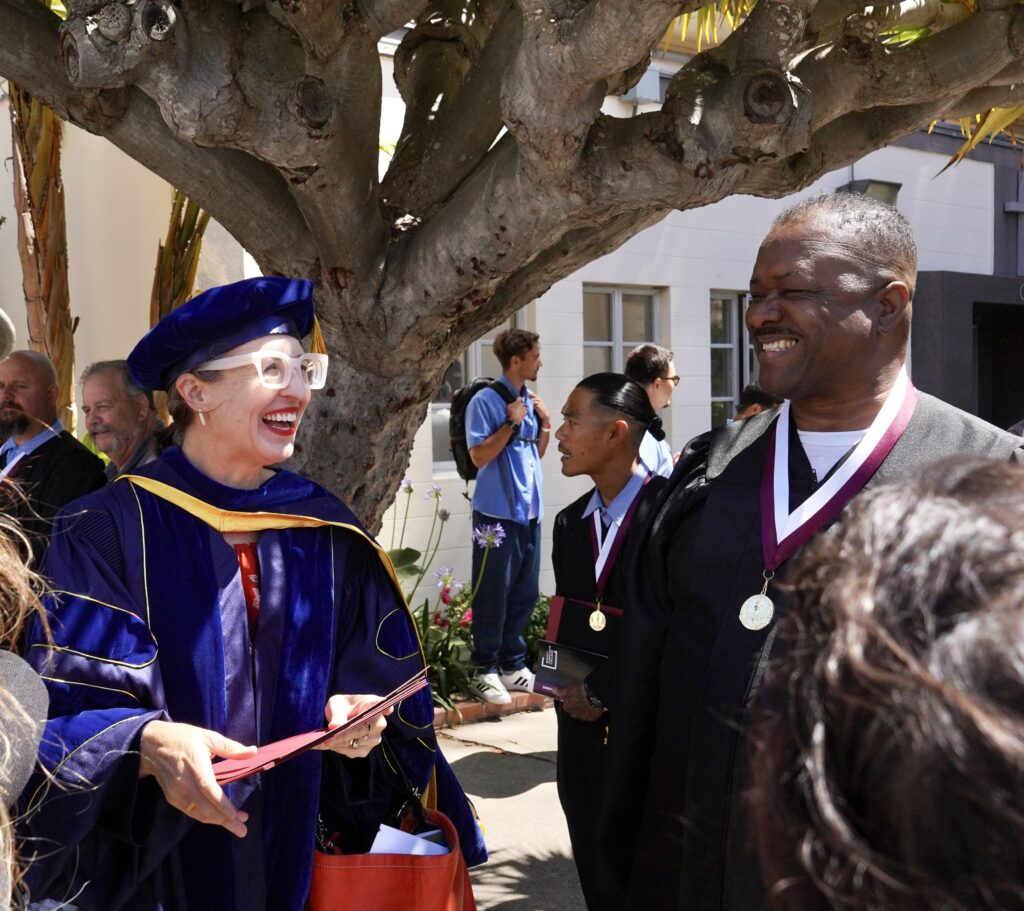
An incarcerated former U.S. Marine Corps veteran speaks about his journey from military service to self-help after years of neglect, drug addiction, and self-realization.
Carl Lewis Raybon Jr., 61, was sentenced to 26-years-to-life for the murder of his girlfriend Patricia B.
As he sat in the Alameda County Jail, Raybon made a commitment to change his ways. He went into deep thought about why he took someone’s life.
“I am accountable for what I did; I was emotionally abusive in my relationship with Patricia, as well as other relationships,” said Raybon.
As churchgoers, Raybon and Patricia B attended Allen Temple Baptist Church in Oakland, California, which included Sunday services and Bible study on Wednesdays.
Raybon was a member of the church’s men’s choir and Patricia B accompanied him to various musical events. They also frequented Cache Creek Casino.
Raybon and Patricia B were together for nearly four months; he hid his crack-cocaine addiction before murdering her.
In 1982, he graduated from Pineforest High School in Fayetteville, NC, and 11 days after graduation he joined the Marine Corps.
Raybon’s biological father and stepfather were both in the U.S. Army; growing up he had an early influence of military service.
Raybon served three years and 10 months in the Marine Corps, and during his first three years of service he received two good conduct medals. The Marine Corps equipped him with an M-16 rifle and a Colt .45 semi-automatic handgun. As a result, he qualified as a sharpshooter.
Raybon went on two deployments aboard the USS Enterprise. Each one was for six months; he had stops in Hawaii, Australia, the Philippines, Hong Kong, Japan, Thailand, and Kenya.
Raybon, as an active member of the military, tested positive for marijuana and was also charged with disrespecting a non-commissioned officer.
The charges led to demotions from corporal to lance corporal and then private first class, losing two ranks.
“My delusional thinking was fear of being rejected. When I would check out from being challenged, I would shut down and become numb,” Raybon said. “In most cases, my numbness would make me abandon my duties and relationships. I was not supportive, I was selfish.”
Raybon said his drug addiction was out of control, which was a factor in his divorce from his first wife, Brenda.
Raybon met Brenda in June 1984 in Waikiki, Hawaii, on his second deployment of sea duty, and did not see her again until seven months later after his deployment was over. He says she played volleyball and basketball for Oklahoma City University, where she attended college.
“She was the love of my life. We married in June 1986, and within the 12 years we had two boys but eventually we grew apart,” Raybon said. “I abandoned my wife and kids. I felt the relationship was over. My character led to bad choices. I was self-centered and had thoughts of worthlessness and rejection.”
Raybon said that through self-realization, he now knows balanced communication is an essential part of a healthy relationship.
Today he says that he is consistent in treating himself and others equally, and being strong-minded has brought awareness to his previous self-defeating thinking that enabled his drug and alcohol addiction.
In June 2025, Raybon earned an Associate of Arts degree from Mount Tamalpais College onsite at San Quentin Rehabilitation Center.
Raybon said that a quality education has taught him so much, that it takes life skills in order to be successful. In the classroom he was able to ask for help, something he previously did not do. He also interacted with his peers in the college’s study hall, where he became more sociable.
Raybon worked as a Mt. Tamalpais College Clerk for two years, and during that time he learned that life is not just about him.
The staff at the college helped him develop into the role of becoming a better listener, which helped him take the negative and turn it into positive without being judgmental.
Amy Jamgochian, Mt. Tamalpais College’s Chief Academic Officer, and Program Manager, Maurice Avello, let Raybon know when he was pushing back too much and they told him that helping the students comes first.
“I now have a host of people whom I can confide in. I did not always have that,” Raybon said. “I do not have to worry about my image. I can just be myself.”
Today, Raybon says that he has a better work ethic that is not hindered by insecurities and low self-esteem. He now understands his previous behaviors, when he didn’t trust himself or others.
Raybon continues to participate in self-help programs and has completed groups such as Guiding Rage Into Power, Veterans Support Group, Enneagram Prison Project, Denial Management, Family Relations, Substance Use Disorder Treatment, and Restorative Justice Victims Impact.
Raybon is currently making living amends that are based upon his determination and purpose to rehabilitate, educate, and employ comprehensive coping skills in order to not repeat behavior that dictated his life. He is currently in the process of filing the necessary paperwork to restore his honor in the military, and hopes to receive an honorable discharge. “It looks favorable,” Raybon said.
“I now know that I have to respect others in order to receive respect,” said Raybon. “I can now sit in a group and talk about my crime. Because of this I feel freedom.”