By Terrell J. Marshall
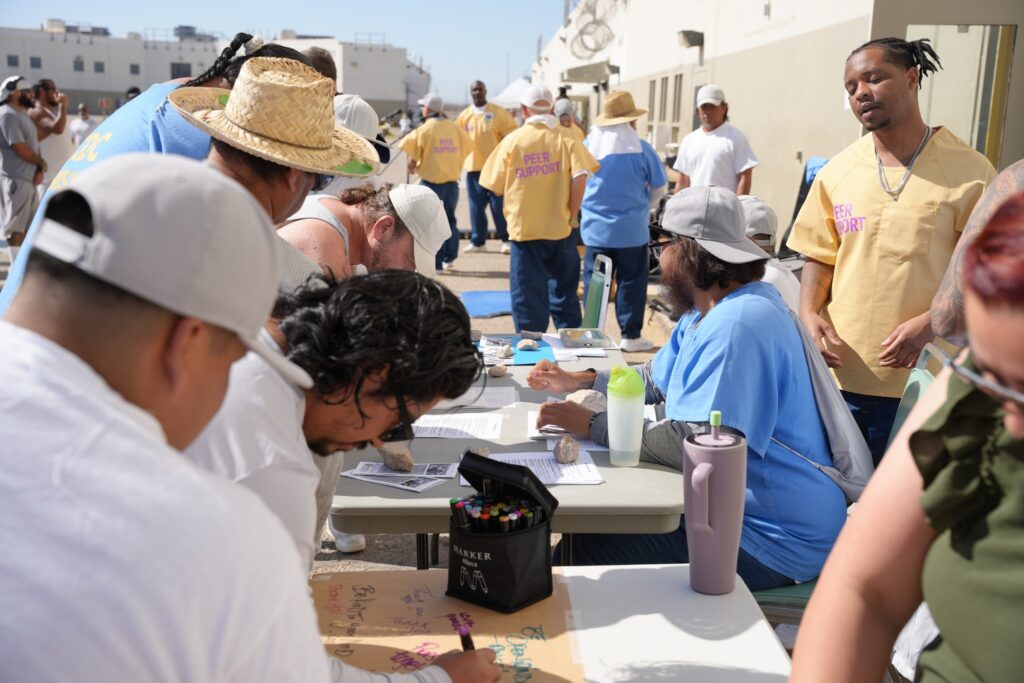
In 2025, the California Department of Corrections and Rehabilitation broke new ground in health care and substance use treatment of incarcerated people by instituting a comprehensive Peer Support Specialist Program.
“To those who now and in the future strive every day to deliver hope and empathy to your respective incarcerated populations, you have our utmost respect and gratitude,” noted the San Quentin Rehabilitation Center PSSP 2025 Achievements and Best Practices report.
Since the beginning of last year, hundreds of incarcerated people across the state were trained, tested, certified, and hired as Peer Support Specialists by CDCR to provide a wide range of support to people among their community.
PSSs use their lived experience with substance use and mental health recovery, along with specialized training, to empower others.
“Our first goal is to build a person’s trust by providing emotional support,” said PSS John Dudley. “Our overall goal is to give individuals the tools and self-confidence they need to find their own path to wellness.”
Since becoming one of 30 certified specialists employed at SQRC, Dudley said he has helped people set goals, find resources, and advocate for themselves by connecting with community and engaging in treatment.
“We facilitate groups, collaborate with care teams, and have one-on-one sessions that help people develop everyday life skills like finding a job, navigating health care, combating triggers, and managing symptoms,” Dudley said.
According to an article in Corrections Today entitled “Peer Behind the Walls,” by Lynn Patrone, the Pennsylvania Department of Corrections was the first to establish the certified peer specialist program inside a U.S. prison setting back in 2012.
Since then, the peer support concept has continued to grow toward improving the health care and addiction recovery of thousands of incarcerated individuals across the nation.
“Implementing the certified peer support program is one such innovation that has far surpassed expectations and is, in part, responsible for changing the culture in how incarcerated individuals are viewed,” wrote Patrone.
SQRC resident PSS Michael Fangman said he recognizes that each incarcerated individual faces a unique set of challenges and stressors. It is his job to support them in a manner that fosters positive outcomes both throughout and beyond their incarceration.
“We can understand and relate to what people are going through because we have all walked in their shoes,” Fangman said. “We show others how we navigated our recovery and inspire them to find their own path to living their best life.”
Fangman said that most California state prisons currently employ up to 30 incarcerated certified Peer Support Specialists who each work up to 37 hours a week.
Four PSSs from Norco state prison recently transferred to San Quentin, and began supporting others in the community as soon as they arrived.
Fangman added that they all work toward the same goal of helping others down the path of recovery by providing hope, role modeling, coaching, and ongoing practical support.
“We don’t do this work by ourselves,” Fangman said. “ We collaborate with the facility’s health care staff, custody, and each other, to provide the best outcomes for our consumers.”
The Paper Trail, published at the Central California Women’s Facility, reported in “A Remarkable Achievement” that 28 CCWF resident PSSs passed the certification test in 2025 and began to help others on their journey toward wellness.
“It feels great,” Lena Coleman said in the article. “Not just my goal being achieved, but in being allowed to serve my community and be proactive. It’s a ‘me’ thing, but more so a ‘we’ thing.”
Paper Trail noted that by working toward and obtaining PSS certification, incarcerated individuals also gain transferable job skills for when they are released and increase the wage they can earn while incarcerated.
GovernmentJobs.com noted that in Marin County, Calif., PSS Counselors have a minimum salary of $58,110 annually.
The federal Substance Abuse and Mental Health Services Administration, along with state health care departments and organizations like Faces & Voices of Recovery, are key funders that give grants to programs like PSSP.
According to the SAMHSA.gov grants page, many grants are drying up and facing significant cuts and uncertainty due to the winding down of the COVID-era funding.
“Executive orders have targeted certain grant types, potentially impacting funding for peer programs,” noted SAMHSA.
Some PSSs have concerns about their jobs disappearing along with grant funding. SAMHSA stated there is a push for more Medicaid reimbursement funds that would replace or supplement the loss of grants.
Other solutions proposed by SAMHSA to support PSSPs include private funding options along with a variety of permanent funding stream solutions.
The SQRC PSSP 2025 Achievements and Best Practices report estimates the total number of peer engagements throughout the year to be more than 26,000.
The budgetary impact of the report states that under its current iteration, SQRC’s PSSP can employ up to 30 peer residents who, upon completing their certification, receive $1.45 an hour for a 37-hour work week. This amounts to $84,825 in annual budgeted “salary” obligations.
To achieve a similar statistical impact, an equally compensated non-incarcerated staff person would need to engage more than 103 incarcerated people every day, “over a myriad of subject and lived experiences they more than likely do not posses,” noted the report.
Dudley said the added value of having an incarcerated PSS who links people to vital community services like employment, housing, and treatment before release is just common sense.
“More than 90% of incarcerated people will eventually be released from prison,” said Dudley. “If we want healthier, more productive people reentering society after they serve their time, it only makes sense to give them the tools and the support they need now, before they hit the gate to freedom.”