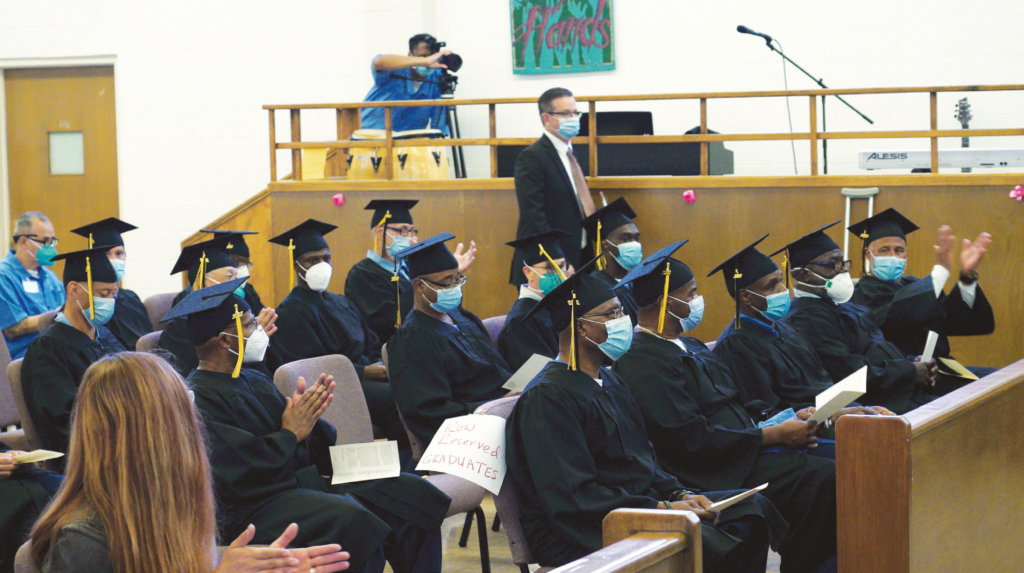
Thirty years ago, what would become Mount Tamalpais College was born in San Quentin State Prison amidst violence, racial tension, animosity, suspicion, and meager resources. The first semester in 1996 consisted of two class offerings.
This April, the college celebrated its 30-year anniversary with a “Together We Climb” gala in San Francisco. Friends and partners of the school joined staff, current and former volunteer faculty, donors, and formerly incarcerated alumni to mark the milestone. MTC President Jody Lewen spoke to the gathering about the college’s origins and future path.
“What began in 1996 under extremely difficult circumstances has grown into an institution shaped by trust, academic rigor, and a deep commitment to human possibility. As we look to the future, our goal is not only to expand access to high-quality education in prison, but to affirm the humanity of incarcerated people and advance the contributions they are uniquely positioned to make to the world,” Lewen said.
Lewen came in to teach for the program in 1999 when it offered 10 classes attended by around 100 students and she stepped into the school’s leadership in 2000.

Some of today’s MTC students would be wide-eyed if they read her description of the College’s early years in December 2025’s “Letter from the President.”
“Most [students] were still writing their assignments with pencil; pens were scarce. Students scrounged together paper from clerical jobs or quarterly packages, and textbooks were donated by publishers or the occasional bookstore,” she wrote.
The college wasn’t called MTC at the time; that would come later. It was an extension of Patten College known as the Prison University Project. For about two decades the school would be the only on-site, degree-granting, liberal arts college in a California prison.
Prison staff scrutinized everything the program brought in and prohibited maps and some books based on the cover or title. Long and frequent lockdowns resulting from violence sometimes stretched 13-week semesters into six-month marathons.
Charges of overfamiliarity led to trips to the hole or bus rides to other prisons. “A teacher talking to a student one-on-one out of earshot of prison staff was viewed with deep suspicion,” Lewen wrote.
She recalled much hostility among prison staff to rehabilitative programs in those early years, but also talked about “a handful of key allies” that made the program’s survival possible. Some staff gradually came to see and respect the change they observed in the college’s students.
Lewen credited those students with a vital role in running the program, including delivering “mountains” of paper and verbal mail, mentoring and inspiring one another, and looking out for faculty and college staff, to name just a few of their contributions.
“The respect that those students earned … eventually formed a powerful protective shield around the college that persists to this day,” she wrote.
MTC produced a “Then & Now Series” to celebrate the anniversary. There, alumnus and 2008 MTC graduate Raphael Calix testified to the transformation he experienced as a student of the school.
“I came into the prison system and found myself hopeless, believing that this was what I deserved in life—to be inside a prison … [The volunteers] brought life into our bones by starting a college program … That writing that I did, that reading that I did, brought me back to life. Literally. I was resurrected,” wrote Calix.
Sharing credit for the school’s success are its all-volunteer faculty, who Lewen acknowledged have for decades faced “… delays, cancellations, scant technology, sweaty classrooms, pouring rain, and Bay Area traffic.” The faculty, made up of professors, graduate students and industry professionals, was a stabilizing force that recruited colleagues and “… forged the philanthropic origins of the fledgling program.”
The perseverance paid off. “Despite political and financial barriers, the college gradually gained trust from prison officials and a reputation for rigor and compassion among the prison population,” noted an MTC press release celebrating the anniversary.
Students, volunteer faculty, staff, donors, alumni, and other supporters all have contributed to position MTC as it stands today: an independently accredited liberal arts college that serves about 300 students each semester. The number of class offerings has more than doubled since Lewen’s first year in the program. The current summer semester lists 22 courses.
Five years ago, the college gained permission from prison officials to open a computer lab in the facility, a breakthrough that provided students with their first access to modern technology. Student Ed Tholl, who served as a Peer Computer Lab Assistant, also testified in the “Then & Now Series.”

“Gaining access to the computer lab was an eye opener—I never thought such a thing was possible inside of a prison … MTC plays a great role in our personal growth and our ability to dream of a better future,” wrote Tholl.
MTC is the first college of its type that serves incarcerated students exclusively with a tuition-free associate degree. Students do not pay for books and, unlike in the early days, they are provided a liberal supply of paper, pens, pencils, highlighters, pocket dictionaries, and calculators in math and science courses, all paid for with donations.
As the college celebrates 30 years of service, San Quentin residents are uniquely positioned to avail themselves of the extraordinary opportunities the presence of Mount Tamalpais College lends to the rehabilitation center.