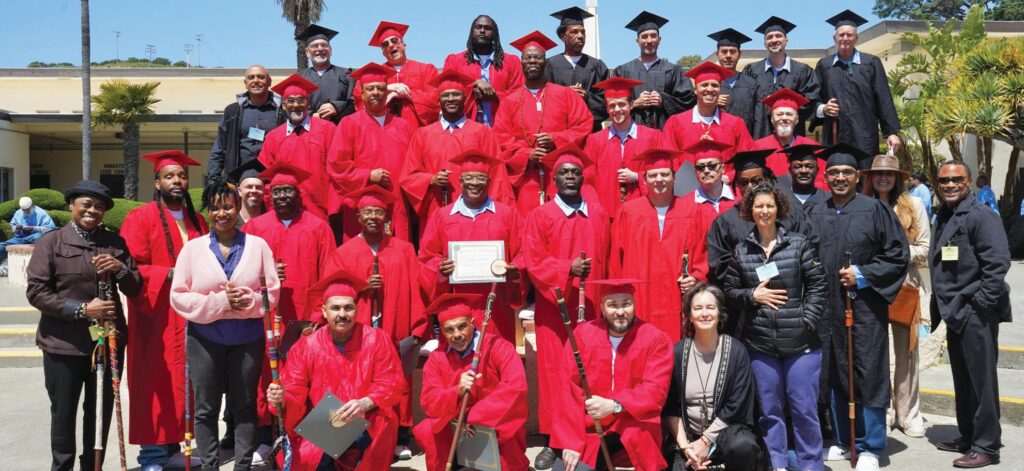
Residents in the transformative mediation program at San Quentin learned that the skills and techniques they’ve been acquiring can lead to employment post-incarceration.
Around 60 outside arbitrators visited the prison, led by Executive Director Deborah Levy of The Congress of Neutrals. The visit was to learn what it takes for residents to mediate under extraordinary circumstances and to understand why those in the mediation program are great candidates for employment opportunities after they leave prison.
“Recently we have seen incredible success by deepening our connection with transformative mediation training happening here in San Quentin,” Levy said. “We have recruited graduates from San Quentin for the last two years [into] our training program.”
TCN offers a 40-hour mediation training program that serves as a gateway for people invested in more holistic ways of resolving conflicts. The organization includes a mentoring program that guides new mediators as they transition from theory to the practical environments of the California court system.
Levy discussed one particular success story from San Quentin who came through TCNs training program: Jose Ramirez.
“There is no better example of this pathway than Jose Ramirez,” Levy said. “He has become one of our most reliable mediators. His success rates in the courtroom have earned him direct praise from judges, who recognized his ability to find resolution in even the most difficult cases.”
The transformative mediation program at San Quentin is supervised by Executive Director Rochelle Edwards of Harm to Health Collective. Incarcerated mediators are challenged to practice professional-level dispute resolutions through reflective listening, emotional intelligence, and understanding body language. But resolving conflicts in a prison setting is unlike mediations happening in society. The biggest challenge is remaining objective in such a small community.
Resident Noah Winchester said his biggest challenge when it comes to mediating in prison is not doing more harm than good. He said the goal is to be careful not to offend while remaining authentic.
“The community here trusts us and if I don’t do it right, that trust can be taken away all because I didn’t handle the mediation correctly,” Winchester said. “One of the tools I use is being able to sit in a mediation and be clued into the body language.”
Incarcerated mediator Vernon Evans said the best part of his mediating comes when he’s able to speak with disputants before the mediation.
“Being able to talk to the disputants before the mediation is where the meat of everything happens,” Evans said. “I find that to be very valuable.”
Evans said he lets the individuals know that he is just a referee and that they will be doing the work. This allows him to set the ground rules early.
Resident Michael Callahan, a facilitator in the transformative mediation program, said that the prison environment is ever-changing and as a mediator, he believes that violence can be curbed through mediations, but the individuals have to feel supported.
“We are out there preaching confidentiality in a space that can be volatile,” Callahan said. “So for me it starts by recognizing if the person feels supported and safe.
Callahan said a tool he uses is role-reversal, where he challenges individuals to find another way of thinking.
Resident Sergio Alvarez is a facilitator for the transformative mediation program at San Quentin. He said that he has learned what listening really looks like and the practice has impacted his day-to-day conversations, especially when he knows a person is not listening to him.
“I used to need people to listen to me, said Alvarez. “But now that I know what mediation looks like, I can be more useful in the community.”
When discussing the challenges of conflict resolutions, Levy talked about her years of mediating and said that the biggest challenge for her has been understanding that people’s perspectives can change. She also said that for her, mediating should come with a goal in mind.
“Ultimately, my job isn’t to coerce a settlement, but by using the tools of validating and pivoting, reality testing and patience, we can work to resolve impasses,” Levy said.
She encouraged the incarcerated mediators to never give up and to know that even the most rigid person’s perspective isn’t set in stone.
Facilitators of the transformative mediation program are trained to be objective and neutral. They learn important skills to facilitate a structured conversation and dialogue.
Resident Benny Espinoza said that creating a safe space for people to come together to be heard is important. He said one way he views success in mediations is in his performance.
“For me, understanding that I did what I was supposed to do and allowing the people to agree on something basic is success to me,” Espinoza said.
Executive Director Rochelle Edwards said that ultimately it’s about harm being healed and repairing what has been broken.
“Mediation exists in the space between what is broken and what is possible,” Edwards said.
Side Bar
To access the services of transformative mediation, send a request for services in a U-Save’em envelope to Transformative Mediation c/o Community Resources Office.
Focus Areas Serviced by Transformative Mediation program
- Cellmates
- Sports teams
- Program
- Workplace
Areas Not Serviced by Transformative Mediation program
- Acute mental health crisis
- Financial disagreements
- Official grievances and 602s
- Individuals unwilling to resolve a conflict