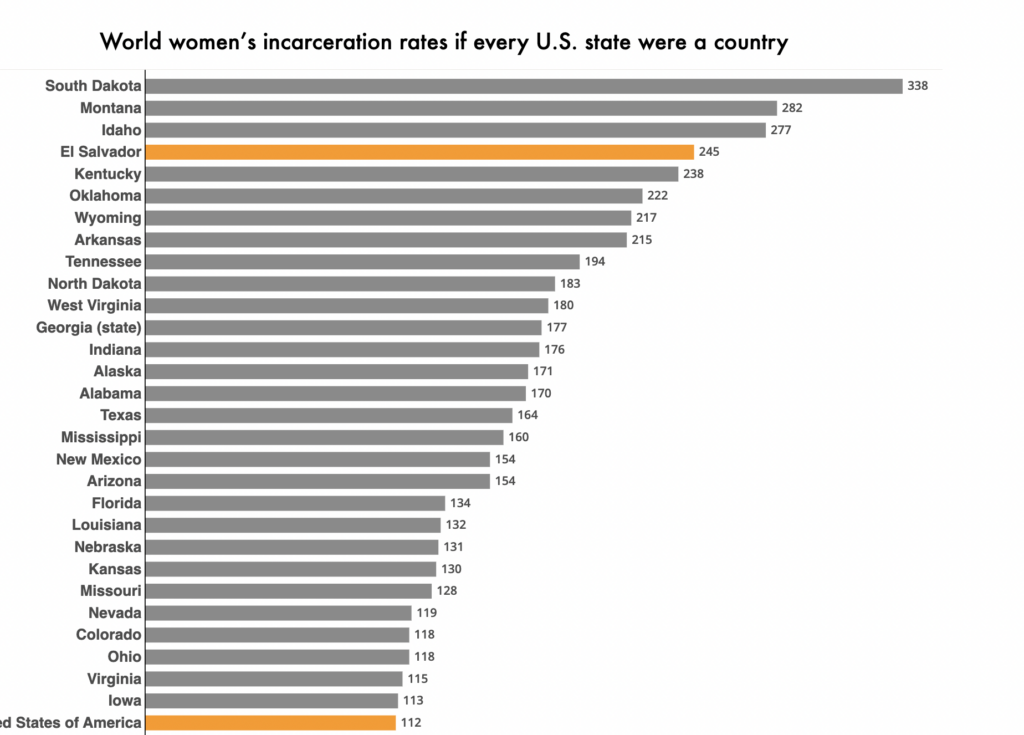
As mass incarceration in the United States is trending down, the incarceration rate of women has increased.
Female incarceration globally has increased 60% in the last 25 years. There are 740,000 women and girls incarcerated in jails and prisons worldwide; 200,000 of them are in the United States, according to a 2025 report from the Prison Policy Initiative.
“Women are particularly vulnerable to laws and practices criminalizing poverty, as well as laws that disproportionately impact them on the basis of their gender or disability,” reported PPI.
The United States contributes disproportionately to the worldwide increase in women’s incarceration. The country imprisons 614 people per every 100,000, and 212 women per 100,000.
The United States locks women up at a higher rate than nations with armed conflict and political instability, where laws openly subjugate women. A case in point shows the state of Rhode Island has the lowest rate of women’s incarceration, but the state imprisons women at a rate of 28 per 100,000, according to PPI.
Incarcerated women have access to fewer diversion and self-help programs than men do, programs that could lead to good time credits, shortening prison sentences, reported PPI.
Women are vulnerable to laws that target reproductive rights, gender bias, and psychological abuse. Women who are incarcerated because of illicit drugs have lost parental rights, and access to essential prenatal care, PPI said.
Incarcerated women in the U.S. report sexual abuse 40% more often than incarcerated men. On a national scale, more than 22% of incarcerated women identify as lesbian, gay, or bisexual, and they make more sexual abuse claims than incarcerated heterosexual women.
PPI reports that 4% of the world’s women and girls live in the Unites States, but the country holds 25% of the world’s incarcerated women and girls. Many U.S. states outpace entire countries in rates of female incarceration.
Rhode Island has the lowest rate of incarcerated women in the U.S. at 28 per 100,000. Comparatively, the country of Columbia has a rate of 23 per 100,000 citizens because of drug laws that unreasonably punish women.
In Columbia, incarceration of women has increased more than 500% since 1991 because of new drug laws that lead to unreasonable punishment of women, PPI reported.
New York State incarcerates women at a rate of 34 per 100,000, the same level as Bolivia. Bolivia’s imprisonment of women increased 12% in a seven-month period in 2024 due to drug-related offenses, according to PPI.
Even nations that incarcerate women at much lower rates than the U.S. imprison women and girls for offenses that have little to do with public safety, according to PPI.
The imprisonment of women worldwide remains a calamity. The incarceration rate of women to men within the US reveals a falsely optimistic picture.
The United States has the lowest levels of women’s incarceration are far out of line with a shameful global status quo.