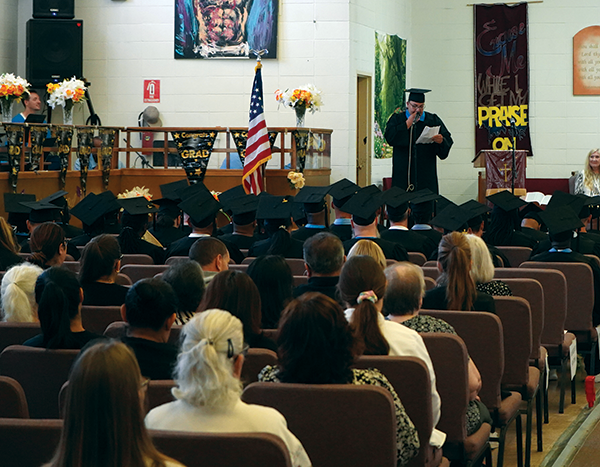
For incarcerated students obtaining a bachelor’s degree, life is changing. Phillip Hernandez envisioned that one day he would graduate from high school, but college seemed like a dream to him and his mother.
“Coming back into prison I had a sense of being a failure. I had a deep sense of loss and I did not know what to do, but I was going to do something,” Hernandez said. “Going to school was the first logical decision I made.”
Hernandez is 49 years old and has been incarcerated for 13 years. He was 18 when he dropped out of high school in the 11th grade because he was told he was too old to finish school. He said that at the time he believed he had a learning disability, and instead of going to continuation school he got into the carpentry industry and never looked back — until he came to prison.
According to Best Colleges reports in 2014, just 1% of incarcerated adults in the U.S. held a bachelor’s, graduate, or professional degree—vastly below the ~17% among non-incarcerated U.S. adults.
The success of prison education programs is measured by two factors: the rate of re-arrest and the individual’s ability to obtain and maintain employment upon release.
The reports indicated consistently that higher education reduces an individual’s chances of returning to crime and increases the chances of finding better jobs. A higher level of education increases the probability of post-release employment, which reduces the chance of recidivism.
“I saw prison as an opportunity to finally finish high school and get my GED. Once I reached that milestone, I wanted more. I realized if I applied myself, I was smart and could achieve great things,” Hernandez said.
In 2016, Hernandez was incarcerated at Corcoran and obtained his high school diploma. He continued to pursue higher education and earned an Associates of Arts degree in sociology/ human and behavioral sciences, and another AA in arts and humanities. He is pursuing a bachelor’s degree in the fall of 2026.
He said obtaining an education while incarcerated was a challenge in itself, but he also struggled with low self-esteem and lacked support for a higher education. “I never felt my mother was ever proud of me growing up,” Hernandez said. “It was an emotional moment for me to have my mother attend my college ceremony. In that moment she was truly proud of something I did.”
In late August, Hernandez and about 25 other incarcerated students signed up for the newly offered bachelor’s program at San Quentin Rehabilitation Center. The opportunity marks a major milestone for correctional education as the newly constructed education center should open in time for the Fall ’26 semester.
Through the program, incarcerated students take one or two courses per semester toward a bachelor’s degree. The coursework equips students with essential thinking skills, writing abilities, and experiences that foster personal transformations.
The school-to-prison pipeline and the cycle of recidivism are two deeply interconnected issues rooted in the same societal dilemmas, but the solution can be partially rooted in our systems of higher education. By educating people who already incarcerated, there can be hope for a society that is not only better educated, but is safer and breaking cycles of multi-generational oppression.
“I remember them handing me my gown. It felt surreal. The process of zipping up the gown and sliding it on felt like a dream. The energy I felt with those around me was infectious; it was one of my proudest moments in prison,” Hernandez said.
Felon-Friendly Industries from reference page Felonfriendlyenvironment.odt
- Skilled Trades & Technical Fields:
- Electrician, HVAC, plumbing, welding, and construction project management.
- Prioritize certifications and skills over felony background.
- Information Technology (IT):
- Coding, software development, web design, and cyber security support.
- Tech companies sometimes use “skills-based hiring” and care less about records.
- Entrepreneurship & Self-Employment:
- Consulting, online business, real estate wholesaling, and e-commerce.
- Gives full control and avoids background check barriers.
- Social Services & Nonprofits:
- Many reentry and recovery organizations hire people with lived experience.
- Case management, peer counseling, and program coordination.
- Transportation & Logistics:
- California Driver License (depending on offense), warehouse management, and supply chain analysis.
- Sales & Customer Service:
- Retail management, insurance sales, and independent contractor.
- Commission-based work is often more open to people with felony background.