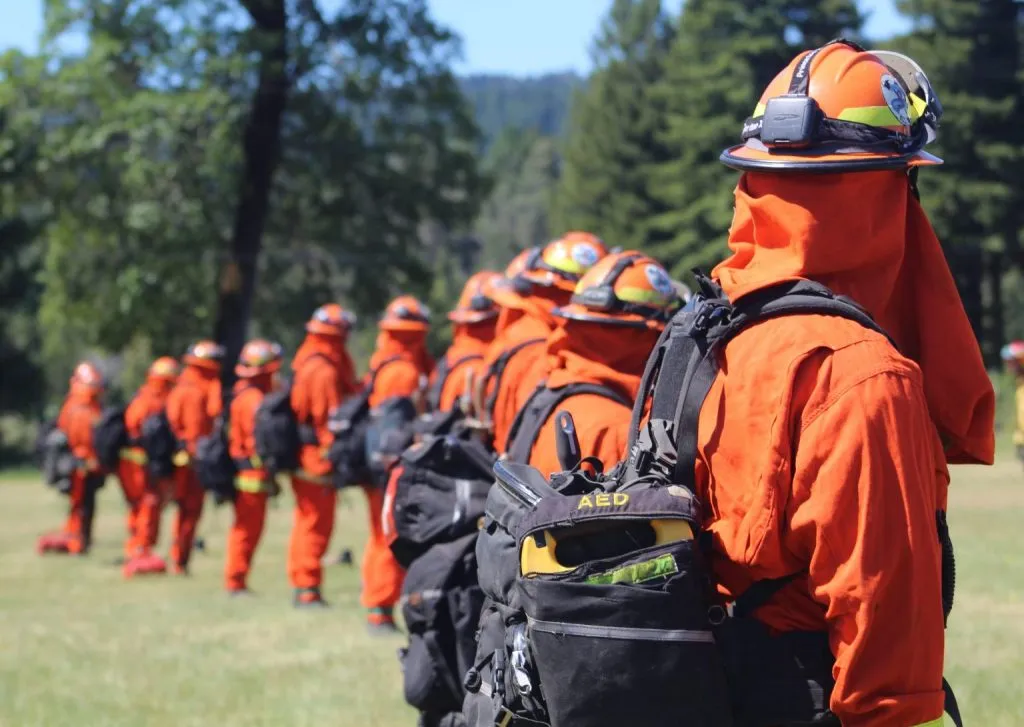
Actor, restaurateur, and activist Danny Trejo and producer David Enabnit visited San Quentin to gather information and talk to residents about an upcoming documentary titled “Trial by Fire.”
Trejo, who has a connection to San Quentin, talked about his experience in several fire camps from the Rockies to the Sierra and prisons including Folsom, Soledad, Tracy, and San Quentin.
“We have dedicated our lives to helping people stay out of prison. Prison is not all the movies said it is,” said Trejo. “Once in the system, you get tied up in it and it’s almost impossible to get out. With all the programs now, it is more possible.”
In addition to the “Trial by Fire” documentary highlighting incarcerated firefighters, California Gov. Gavin Newsom signed a series of bills regarding incarcerated firefighters, one of which included a wage increase funded by the state budget, on Oct. 13.
The 1,800 firefighters who provide critical support during fire season live in minimum-security facilities around California called “fire camps.”
Currently, an incarcerated firefighter can receive between $5.80 and $10.24 per day with an additional $1 per hour during active emergencies, according to CalMatters. Now, incarcerated firefighters will receive a federal minimum wage of $7.25 an hour during active emergencies.
Katie Dixon, the policy and campaign coordinator for California Coalition for Women Prisoners, an organization that supported the bill, gave credit to the people fighting the fires.
“I feel like this is a statement of value — in saying, ‘we value you, we honor you, we see you,’” Dixon said.
Dixon served two years of incarceration at a fire camp. She worked with the hand crew battling hundreds of fires, but after being released in 2012, she said she learned that her experience did not lead to a promising career because she had a criminal record, the report said.
“It felt like a dream deferred. A dream that’s been cut off due to systemic policies designed to keep people like me — Black people — out of certain professions,” Dixon said. “Deep down inside, I’m supposed to be a battalion chief.”
Assemblymember Isaac Bryan (D) from Culver City initially authored the bill to increase wages to $19 per hour, but negotiated down to match the federal minimum wage.
“It’s the right thing to do and it’s long overdue,” Bryan told CalMatters. “It feels really beautiful and life-changing for folks who have sacrificed to save others during their time being held accountable for whatever harms they may have caused in their past.”
Trejo, who went to the parole board in July 1969 and was released on Aug. 23, 1969, talked about his involvement with rehabilitation initiative programs, including those for people interested in pursuing careers in firefighting. His documentary is a chronicled journey of incarcerated firefighters rebuilding their lives through programs and skill development.
“Anything that’s ever been good for me has come from helping someone else,” said Trejo.
The bill raised concerns with the California Sheriff’s Association, which cited the fiscal impact the bill may have on the counties, according to CalMatters.
U.S. representatives Sydney Kamlager-Dove and Judy Chu from California introduced a bill that would allow incarcerated firefighters to have their records cleared, which would remove one of the barriers a person with a criminal record faces when seeking employment.
“…[A]s we are seeing that it is harder to recruit and retain firefighters, why would you miss an opportunity like this to connect a pipeline that is trained right into municipalities that need more firefighters?” said Kamlager-Dove.