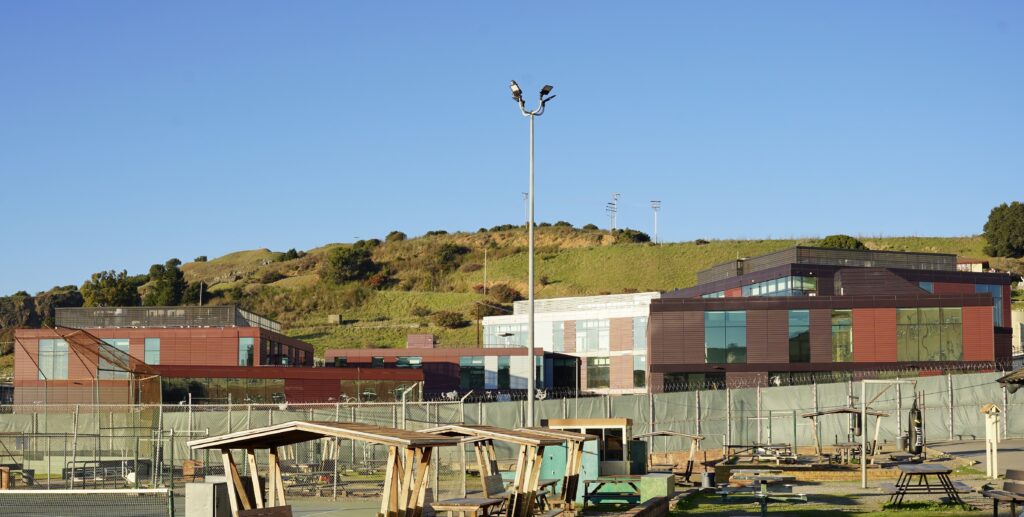
While San Quentin moves full-steam ahead with its reimagining of a better way to operate prisons, many residents believe reform should happen long before incarceration.
San Quentin has refashioned itself as a rehabilitation center, spending hundreds of millions of dollars building a new education campus to prove its dedication to change isn’t just lip service.
Slated for a 2026 opening, the new campus will feature a state-of-the-art media center, library, and college classrooms as just a few of the resources that will be available to residents. According to the Legislative Analyst’s Office, roughly $240 million of taxpayer funds were allocated for the construction of the campus.
Some San Quentin residents believe real solutions will come from thinking outside of the box, starting with education.
“Funding education is like watering a plant. If you pour into education in the neighborhoods, the youth will flourish, and less people would come to prison,” said Curtys Taylor, an SQ resident who has been incarcerated for 10 years.
Plenty of research has gone into studying the school-to-prison pipeline, finding serious correlations between a child’s poor literacy skills and dropout rates, and the likelihood of them going to jail or prison. According to the National Adult Literacy Survey, 70% of all incarcerated people in the United States are unable to read at a fourth-grade level.
“Schools need more money, more supplies, and better teachers with better pay,” said Johnny Payton, an SQ resident who has been incarcerated for 14 years.
Payton believes that education systems inside of marginalized communities should focus on science, technology, business management, and various trades in order to make youth more competitive in the future job market.
“Improving education in the communities would be a better use of the money instead of putting it into prisons,” Payton said. “Create the opportunities and it will eliminate the reasons many guys come to prison in the first place.”
According to the Legislative Analyst’s Office, the California Department of Corrections and Rehabilitation budget for the current fiscal year is $14.3 billion. CDCR is projected to receive $127,800 for the 2025–2026 fiscal year for every person the department incarcerates; the average annual salary for a CDCR correctional officer is $96,659.
In contrast, the California Department of Education reports the average annual salary for a public school teacher in the state is $101,084, and varies widely depending on location and experience.
The Los Angeles Unified School District, one of the largest in the country, had a budget of $18.8 billion for 2025. Much of this was pulled from reserves in order to cover huge deficits that will likely lead to future cuts in staff and resources, according to NBC News.
Annual tuition at the University of California is $68,237, according to its financial aid department. It cost between $50,000 and $60,000 to send a child to one of California’s private college prep high schools, according to Think Academy. These figures are half of what it costs to keep a person in prison for one year.
The cost to educate someone at a trade school, where a person can learn to be anything from a barber to a plumber or electrician, is even less. For example, Los Angeles Trade Technical College has an annual tuition of just $1,238.
The famed abolitionist and social reformer Frederick Douglass once said, “It is easier to build strong children than to repair broken men.”
Some SQ residents said that they are taking these words in stride, while developing alternative solutions to mass incarceration.