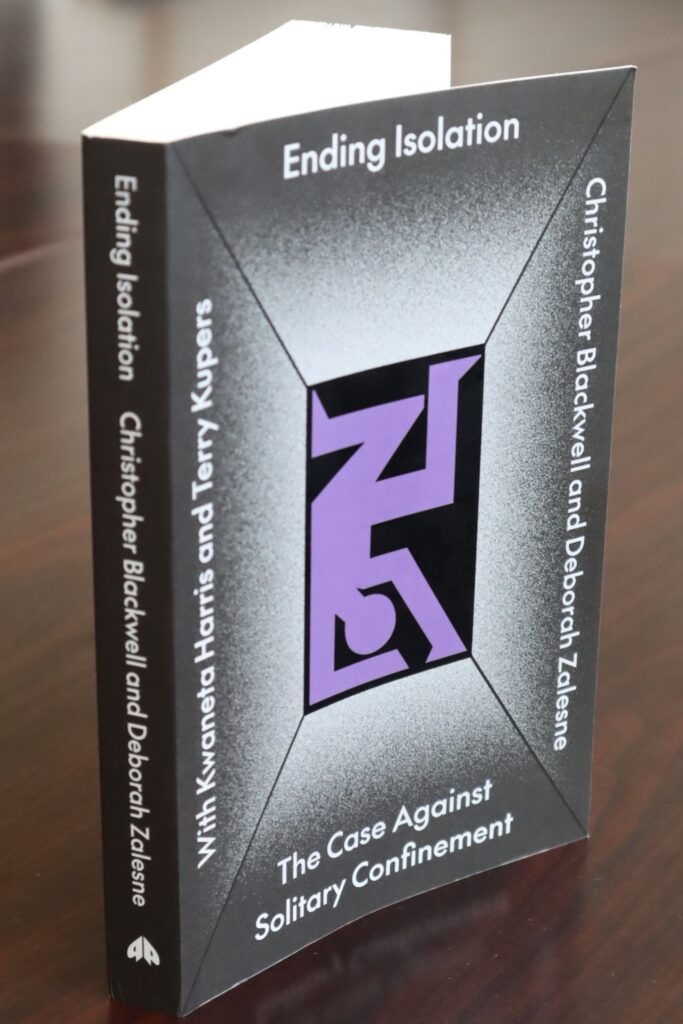
In the United States there are many incarcerated people serving time in solitary confinement who are subject to daily inhumane conditions.
From an incarcerated perspective, and someone who spent over a decade in isolation, I can relate to the push to end isolation. I, too, spent years in multiple security housing units within the California Department of Corrections and Rehabilitation, including the SHUs at Pelican Bay State Prison and Corcoran State Prison.
In “Ending Isolation, The Case Against Solitary Confinement,” authors Christopher Blackwell, an incarcerated journalist, and law professor Deborah Zalesne compiled stories of incarcerated men and women who are currently serving their sentences in isolation or have spent years behind the glass windows without any real human contact.
“While in the juvenile prison, I refused to follow rules and be controlled by authority figures — I rebelled, constantly. This led to my first solitary confinement at age 12, an experience that solidified my distrust for authority figures forever and drove me into a deep hate for ‘the system.’ They warehoused me until my sentence came to an end,” said coauthor Blackwell.
Through personal narratives, this book hits strong points on how prison administrators across the nation use isolation to punish and retaliate against the incarcerated. In addition, it gives the perspective of professionals on isolation, and that of former employees who decided to leave their jobs after witnessing firsthand the dreadful conditions that people endure daily inside these modern dungeons.
Jeremy Busby is an incarcerated journalist in Texas. He talked about his own personal experience, pointing out that Texas is a brutal place to serve time. He stated that most of the world knows this by watching how often executions are carried out there. He compared restricted housing units, where he has been held for years, to the execution chamber.
Busby compared the three-ingredient cocktail of the death chamber to solitary confinement. There, thousands of incarcerated people are subjected to a “… deadly three-ingredient cocktail of severe isolation, extreme deplorable living conditions, and inadequate mental and physical health care, which results in cold-blooded state-sanctioned murder.”
According to Blackwell and Zalesne, solitary confinement was first introduced in the late 1790s at the Eastern State Penitentiary (or Cherry Hill). In 1826 it was established and came to be known as the Pennsylvania model, in which incarcerated people were confined to their cells and unable to speak or communicate with others. This approach of incarcerating people was highly influenced by then Quaker philosophy.
Quakers believed that isolating men under the harsh conditions of a cold concrete cell would give them the time to reflect, study and even pray in order for them to leave their “criminal ways behind.” This barbarian and inhumane practice continues to be one of the deadly punitive approaches to incarceration.
According to professionals, even hundreds of years later this practice continues to be in place by subjecting people to horrible conditions.
Steven Nall spent five years in solitary confinement after he had an altercation with some guards. He recalls being roughed up and taken to an isolation cell where he was stripped of his clothing. The cell didn’t have a mattress, but rather a one-inch-think rubber pad. According to Nall, the door to the recreation yard was kept open on purpose to let the winter air in.
“After this was done, the guards placed a fan in front of the door, turned it on high, and pointed it right at the isolation cell I was in. You have no clue how cold those next few hours were … I had to earn my humanity back, clothing, and eventually a regular cell with a mattress.”
Examples like this one in “Ending Isolation” reminds the reader that no human being should be forced to endure such abusive or barbarian conditions regardless of what they may have done to earn them a ticket to the hole.
Jeremiah Bourgeois survived seven and a half years in isolation. He shared how he was denied most of his meals for three full weeks. He remembered being able to smell the eggs early in the morning as the cart moved closer.
“After the officer handed the guy on the right side of my cell his tray, they bypassed my cell, handed the guy on my left side of my cell his tray, and then continued down the tier. They never looked in my direction. They never said a word. Lunch arrived four hours later, and again I was skipped,” reported Bourgeois.
Ms. Kwaneta Harris writes about the horrible conditions and harm that solitary has had on her and other females. She also dives deep into the negative effects of solitary confinement and how it distanced her relationship with her daughter Summer Knight, whose entire childhood was with her mother in prison and in solitary.
“We only had one five-minute phone call every 3-4 months after midnight, when Summer was already asleep. It was like that for seven years! Sometimes because of staff shortages, the calls would be twice a year!” Summer came to believe that her mother Kwaneta was living inside a hole.
Micaela E. Romero, an expert at Neural Systems and Behavioral Research at the University of Washington, investigates neurobiological and behavioral impacts of social isolation. She discussed the physical and psychological harm of solitary confinement.
According to Romero, “… incarcerated individuals are subjected to conditions that many may consider too harmful even for many lab animals. In practice, the conditions incarcerated individuals face receive less ethical scrutiny than those lab mice.”
She added that after hundreds of years using solitary confinement against incarcerated people there is no substantial evidence that this practice makes communities safer. On the contrary, there is “… overwhelming evidence that it causes harm and premature death.”
I highly recommend this book as one of the top ten best collective items because it makes a strong case for ending isolation. Read this book.