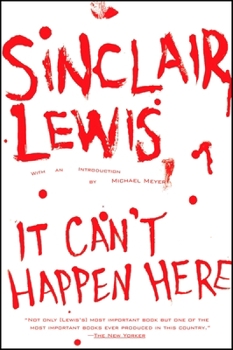
Could a president of the United States ever dismantle democratic institutions, silence the press, and establish a paramilitary force to crush dissent to save America?
“It can’t happen here,” said the character Doremus Jessup, a small-time Vermont newspaper editor, in chapter 16 of Sinclair Lewis’s novel It Can’t Happen Here (1935), written some 90 years ago. Lewis preceded Jessup’s answer with the prophetic quotation, “He simply did not believe that this comic tyranny could endure.”
Jessup’s disbelief concerned the fictional 1936 win of Senator Berzelius “Buzz” Windrip, “the first president inaugurated not on March fourth, but on January twentieth, according to the provision of the new Twentieth Amendment….” Windrip defeated Franklin D. Roosevelt, who “declined to be present” at the inauguration.
Windrip’s followers took his win as “A sign straight from Heaven … that proved that Windrip was starting a new paradise on earth.” Chapter eight showed that Windrip had a plan, a “Project 1936” of sorts, which he called “The Fifteen Points of Victory for the Forgotten Men.”
Point Five said, “Annual net income per person shall be limited to $500,000. No accumulated fortune may at any time exceed $3,000,000 per person.” Such an idea—even without a translation into today’s dollars—would certainly rid the world of a billionaire oligarchy and its disproportionate power.
Jessup’s small voice in his small newspaper opposed Windrip at every stage of his takeover. The novel read like a how-to on taking over the U.S. A large part of the novel also concerned redistricting, not just in one state, but everywhere. Concentration camps appeared in chapter 30, and Jessup inevitably ended up in one.
In chapter 35, President Windrip, who considered Canada his property by manifest destiny, expressed anger that the neighbor to the north showed “no helpfulness about becoming part of his inevitable empire.” In the same chapter, his vice-president quit. Lewis did a great job with portraying the timing of the slow motion takeover in a speed that would not bore the reader.
In this political apocalypse, the press fell first and then came universities. Arrests of college professors started in chapter 32, with the arrest of a Black professor at Howard University whose “professorship was taken over by a most worthy and needy white man….” A few paragraphs later, the Black professor joined Jessup in a concentration camp.
Much of the story took place at the Ivy League Dartmouth College, in Hanover, New Hampshire. Since 1928, Lewis had lived in Barnard, Vermont, not far from Dartmouth, in a house he bought for his wife, the journalist Dorothy Thompson.
Mark Schorer’s biography Sinclair Lewis: An American Life (1961) detailed that Thompson had interviewed Adolf Hitler in 1931 but three years later found herself expelled from Germany. Schorer said Lewis could not have written the novel without Thompson’s help. She supposedly helped him with other books, too.
By 1935, Lewis, the first American recipient of the Nobel Prize in Literature, had already written the excellent novels Babbitt, Main Street, and Arrowsmith, all timeless classics that no one should miss. It Can’t Happen Here, though, has none of the gorgeous descriptions of Lewis’s previous books; it read more like a proofed first draft. Schorer said Lewis started the novel in May 1935, and rushed it to a publisher August 12. It appeared October 21, 70 days later, which even today would seem a record for such a long book.
Despite the sorely lacking literary quality, the work made up with its prescience. Lewis’s novel has kept warning Americans for the last 90 years. It read like a distant mirror about media manipulation, the erosion of democratic norms, and the normalization of extremism. Could such a dystopian scenario ever happen in these enlightened times?