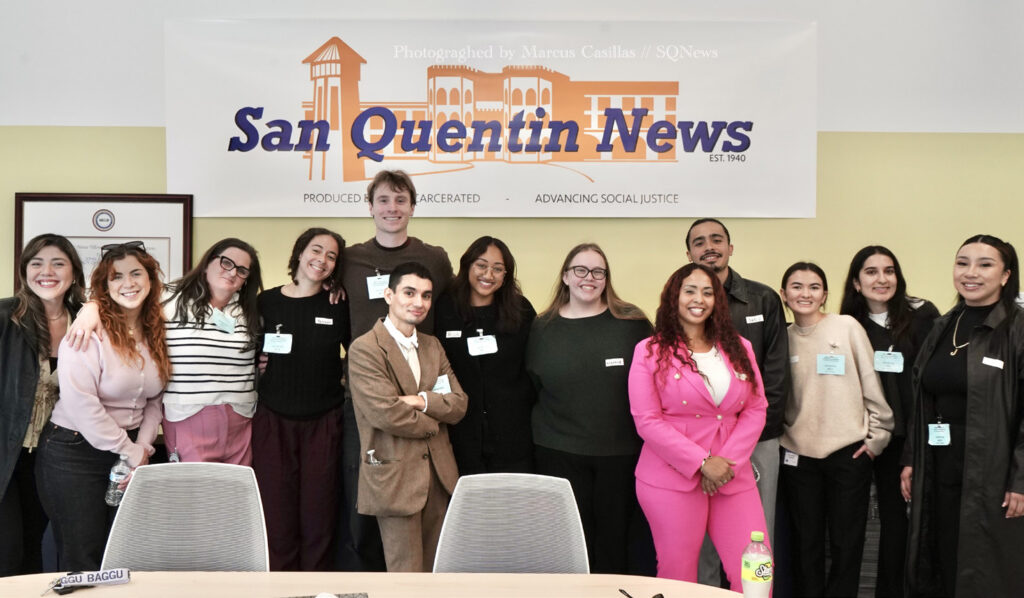
Thirteen law students, all of them aspiring public defenders, participated in a symposium with San Quentin Rehabilitation Center residents in Chapel B on Thursday, April 9.
The law students attended a variety of Bay Area law schools, from the Monterey College of Law to the University of San Francisco Law School. Many of them said they have internships with the Office of the Public Defender in San Francisco and added that they hoped to work there full time after graduation.
“I like helping the community and people in need of a fair trial,” said Angel Farfan, a student at Monterey College of Law. “Defending the weak is in my nature. I want to do as much as I can so that I can feel good about it at the end of the day.”
The event followed the familiar San Quentin format of guests sitting in a large circle interspersed with San Quentin residents who introduced themselves by name, county of commitment, offense, and sentence. Resident host Eric Allen started the event with a presentation, followed by smaller discussion circles.
Allen’s remarks immediately set the tone of the event with the pointed question, “Who here had a public defender at trial?” The answer demonstrated the importance of public defenders as 23 of the 26 partaking residents — or 88% — raised their hands. Of the 23 public defender clients, 17 — or 74% — had an opportunity to plea-bargain with prosecutors.
The concept of public defenders celebrated its 63rd birthday March 18. In the 1963 U.S. Supreme Court case of Gideon v. Wainwright, Clarence Earl Gideon sued Louis L. Wainwright, the Director of Corrections of Florida.
According to Westlaw, Gideon engaged in the breaking and entering of a poolroom. His crime did not succeed. Appearing in court without a lawyer and without funds to pay for one, he asked the judge to appoint counsel for him.
The judge said, “Mr. Gideon, I am sorry, but I cannot appoint Counsel to represent you in this case. Under the laws of the State of Florida, the only time the Court can appoint Counsel to represent a Defendant is when that person is charged with a capital offense.”
Gideon replied, “The United States Supreme Court says I am entitled to be represented by Counsel.”
This brief colloquy initiated one of the most groundbreaking reforms in constitutional criminal procedure. Gideon v. Wainwright required the states to provide counsel to all indigent defendants. “Gideon today is an icon of the American justice system,” said the Iowa Law Review.
During the small circle discussions, law students and residents addressed the role of public defenders and whether they adequately served the criminal justice system. Farfan, the student at Monterey College of Law, said, “Good communication between counsel and client is absolutely essential. The more the public defender knows, the more the public defender can do. Without good communication, very little gets accomplished and a client may be found guilty. Even though public defenders don’t get paid by the client, they still do good work.”
Resident Donald Randolph said he had often thought of public defenders as “public pretenders,” but the symposium had changed his mind.
“In Alameda County, we had the familiar problem of poor communication with public defenders and not getting full discovery. Now, sitting here, hearing and feeling the sincerity, compassion, and understanding was eye-opening. I truly hope the public defenders who came here can keep these characteristics,” Randolph said.
Allen, the host, thought of the event as powerful. “It’s great to have new public defenders overcoming past perceptions of ‘public pretenders’ who don’t really help you but just get you through the case. These future public defenders here can move the system in the right direction,” Allen said.
Law student Jackie Carrillo said she had done lots of work for victims, which gave her a good background for her goal of working as a public defender. Carrillo said she had come to San Quentin primarily to learn from the residents. “I am a student in my last year at SF Law and we all feel privileged to be here. There is something very special about the atmosphere at San Quentin,” Carrillo said.