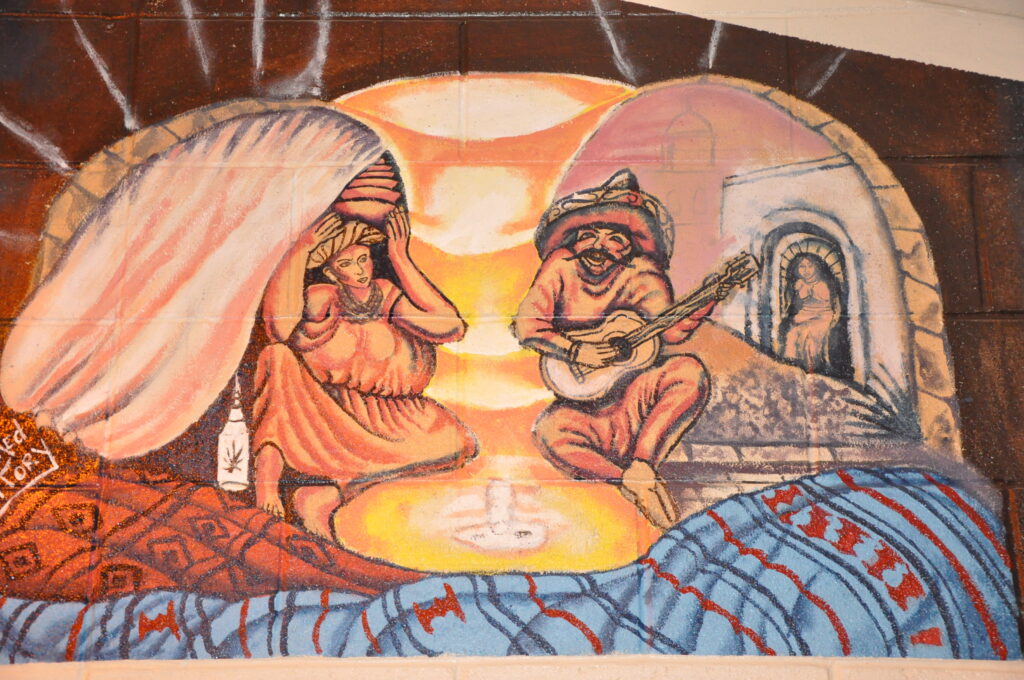
Two residents turn their love for art into rehabilitation and a way to break down long-standing barriers.
If a person walks around the dorm and office areas of San Quentin’s H-unit, they will see murals emblazoned on the lockers of many of the officers and staff. Depictions of the Muppets, scenes conjuring the “Wild West,” and the San Francisco 49ers logo pop out, as if life-like. In dorm one, there is a huge mural of San Francisco Bay — Golden Gate Bridge and all — covering one of the walls.
Above the Bay Area mural are the words “Bridging the Gap,” and that is exactly what Jaime Villafan and Alejandro Perez do with their art.
“The cops saw me drawing one day and they liked my work, and asked me to start doing work for them on their lockers,” said Villafan, who learned to draw at age 12 while serving time in juvenile hall.
Villafan was arrested for vandalism when he was younger because of the graffiti art he would paint on buildings. In a stroke of irony, Villafan’s art now helps him build healthy relationships with correctional officers.
“I used to resent cops because of how I grew up and the environment I was in, but now I can see that not all cops are bad. They are people just like us and they have a job to do,” said Villafan.
With more than 25 years in the criminal justice system, Villafan has seen volatile relationships between correctional officers and incarcerated people. He appreciates the recent positive shift he has observed.
Aside from helping him connect with the officers and other staff, Villafan uses his art to stay productive and maintain peace of mind.
“Art is therapy because it helps pass the time. I feel accomplished and fall in love every time I do something new.”
The same is true of Allejandro Perez, who got into painting by designing low rider bikes and cars when he was younger. He started drawing six years ago as a way to pass the time while in L.A. County jail. He said the art he produces helps him escape his prison environment while developing new ways to approach life.
“Drawing has helped me become more patient, because sometimes a particular piece can take time. It teaches me how to take my time with life,” said Perez.
Perez is glad that his art has created bonds between himself and officers. He sees their perspective change as they appreciate the talent and the hard work that goes into creating a piece.
“I never had a real problem with cops. A lot of what I thought about them was connected with what I believed they thought about me,” said Perez. “My experience has changed my perspective to see that not all officers are the same.”
Upon his release, Perez plans to use his talents to help him navigate life while he rebuilds relationships with his family.
Once he paroles, Villafan is eager to continue drawing as a way to build his career and inspire his three kids, who are his biggest motivation. He will return to his hometown of Merced, Calif. and work to start a clothing brand.