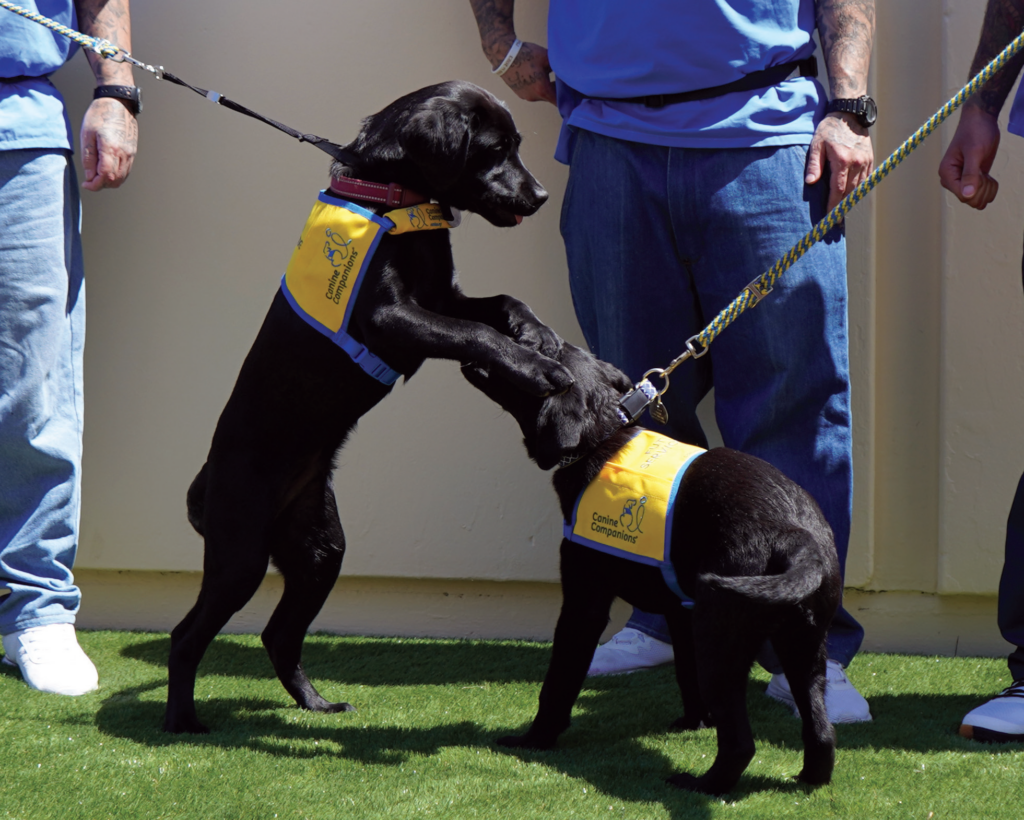
One dog at a time is being trained in the shadow of a notorious cellblock at San Quentin Rehabilitation Center, where lies an oasis of tranquility, training and healing.
SQ resident Jared Hansen, 42, never imagined being a part of a dog-training program when he was transferred to the prison. He grew up in San Diego, California, without a dog; his family could not afford a pet, but he loved playing with the neighborhood dogs.
Hansen was accepted into the Canine Companions program and introduced to Artemis, a four-month-old Black Labrador; it was a moment he will always remember.
“The first night I couldn’t sleep. I kept looking under the bed at Artemis. He’d be looking back at me, [and] it was sort of creepy,” Hansen said.
Hansen’s journey officially began April 4, 2023, when Canine Companions delivered Artemis and Wendell, the first two dogs to be trained. As cellmates, Artemis and Hansen would spend huge amounts of time together within the next year.
Hansen now trains dogs for a minimum of two hours a day on the West Block recreation yard. What looks like sport and play, when Artemis is chasing Frisbees and balls, is actual training.
A partnership between Canine Companions and SQ allows qualified residents to interact with dogs in prison. The 50-year-old non-profit organization provides service dogs — at no cost and for life — to people with disabilities.
The first dog program was established in 1995 at Coffee Creek Women’s Correctional Facility in Portland, Ore. Since then, Canine Companions says they have established 50 dog programs in prisons across the nation.
According to the American Kennel Club, the national success rate for a service dog training program is roughly 50%, and dogs trained in prison programs, like San Quentin’s, have a higher success rate, right around 60%.
The dog park where the training takes place is roughly half the size of a basketball court in length and is surrounded by a waist-high wooden fence.
There is artificial turf, a canopy for shade, some chairs and a giant mural depicting an outdoor-park-like theme, complete with dogs and trees that give the area a peaceful vibe.
In the beginning of 2023, word quickly spread across San Quentin that a dog program was on the way.
Several SQ residents have been in prison for decades; some of these men haven’t seen a dog in over 40 years. The idea of having a canine companion running around the prison was mind-blowing for them.
The requirements to become a dog handler were: first an incarcerated person had to be disciplinary free for three years; then there would be a lot of responsibility and trust required, according to SQ’s administration.
“The directors gave us professional training and a lot of support,” Hansen said. “It was very challenging at first, but once I saw some success, it was very rewarding.”
According to Canine Companions, there were 42 cues that Artemis needed to learn. Behavioral science, impulse control, and self-regulation all had to be taught. Hansen had his hands full, but he was up to the challenge.
“My whole program and attitude changed. I found something special,” Hansen said. “This is not like doing prison time; it’s brought my life peace.”
With 10 years left to serve, Hansen said dogs give him an “emotional boost” and stave off loneliness. He had found his calling, and he hopes to be part of the program until the day he walks out of prison a free man, and maybe even after.
“Dog trainers don’t make a lot of money, but I could see myself doing this after I get out,” he said. “It’d be a great second job.”
As Artemis grew in size, so did the program. Every three months, another two dogs were delivered to San Quentin.
Hansen said he took his role seriously, and within a short period of time he became the lead trainer for the other incarcerated residents fortunate enough to be accepted into the program.
Then came the day that Hansen had to say goodbye to Artemis. Every dog that arrives at San Quentin will eventually be released back into society, paroled to a life of loving service.
After 12 months, Artemis would graduate from prison and begin “phase two,” consisting of six to nine months of professional training through Canine Companions.
A whole year had passed, and Artemis was ready to begin phase two of the program.
“Two weeks before Artemis was leaving, I began to grieve. I started handing him off to other guys, distancing myself because it was going to break my heart,” Hansen said.
Hansen had no say where Artemis would end up. He had done his best and prayed that the dog he spent a year of his life with would provide meaningful service to someone who loved him as much as he did. However, it would not be the last time they would see each other.
A couple of times a year, Canine Companions hosts a two-week-long meet and match on its Santa Rosa, Calif. campus. The purpose is to match the fully trained dogs with people in need of a service dog.
A man named Ben Carter was one of these people. Carter was a veterinarian from Portland, Ore., who was part of the dog program at Coffee Creek from 2016 to 2018.
But in 2018, Carter had back surgery and was paralyzed. He wound up in a wheelchair. The man who devoted his life to helping animals was now in need of a service dog himself.
The clinic Carter worked at had even sponsored a dog. This means they paid all the costs associated with training that dog to become of service, which could be up to $60,000.
Carter was placed on a waiting list, and a few years later, he was at the Canine Companions event. By the end of the event, Carter wrote only one dog’s name on a card, “Artemis.” He even underlined it, punctuating his desire for the dog. As fate would have it, Artemis had the special training that Carter required and he took Artemis home.
On March 28, 2025, one day before Hansen’s 42nd birthday, Carter and Artemis came into San Quentin. Hansen got to meet the man who took Artemis home. It was one of those moments in life that neither man will ever forget.
For Hansen, seeing Artemis again was a joy and a blessing, a reminder of the journey they had started together.
“My mind was blown. It was amazing,” Hansen said. “That was the moment that solidified why I’m doing this. Second happiest day of my life, behind the birth of my daughters.”